

Strait of Hormuz tension 2026 has reached its most dangerous point in decades. Iran’s Revolutionary Guard Corps (IRGC) is seizing commercial vessels, firing on India-bound oil tankers, and threatening to close the Strait of Hormuz — a chokepoint that carries not just 20–25% of the world’s crude oil, but also critical LNG shipments and fertilizer trade that directly affect global food security. The Strait of Hormuz crisis now involves the US, China, India, and global energy markets simultaneously — making it the defining geopolitical flashpoint of 2026.
Why the Strait of Hormuz Is the World’s Most Critical Chokepoint
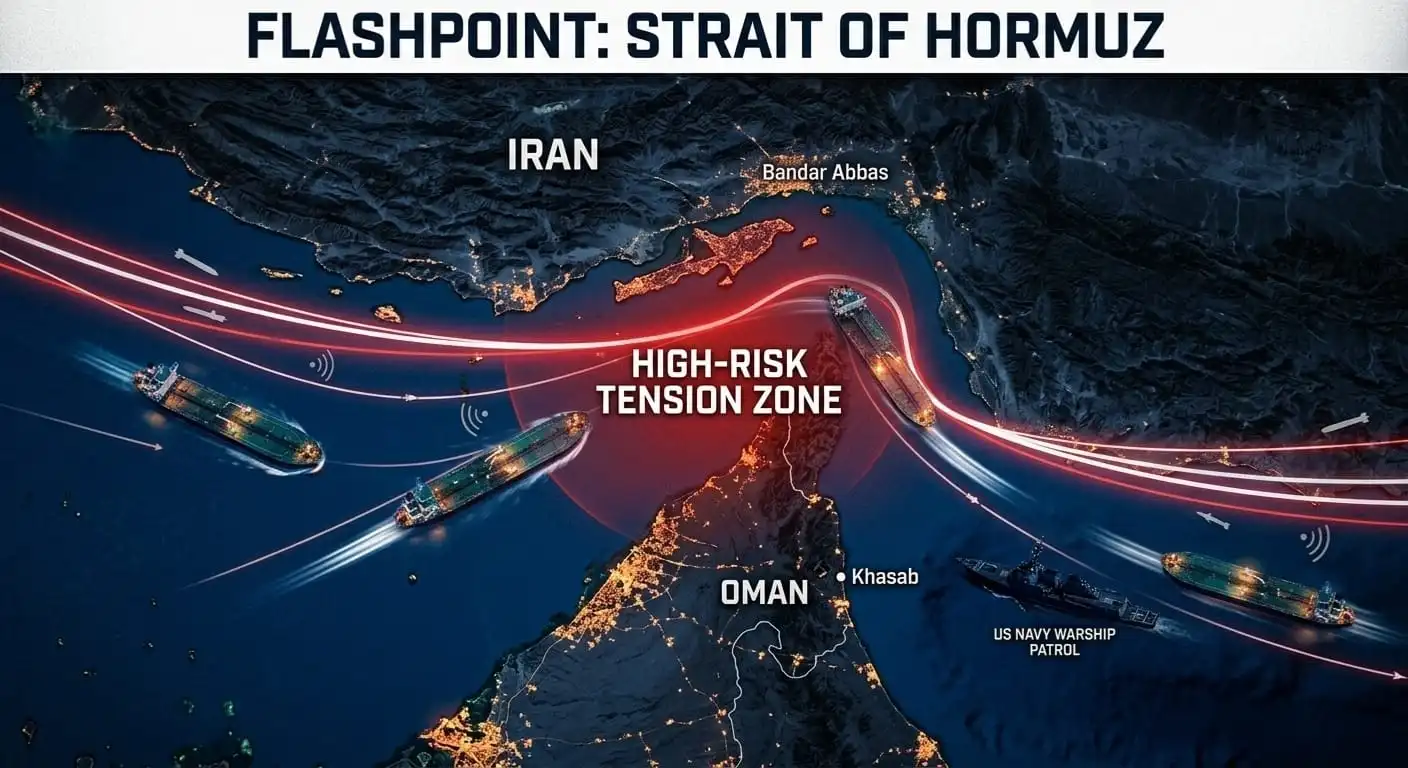
The Strait of Hormuz is a narrow 33 km-wide waterway between Iran and Oman — the only sea exit from the Persian Gulf. Every day, tankers and cargo ships carrying crude oil, LNG, and fertilizers from Saudi Arabia, Iraq, UAE, Qatar, and Kuwait pass through this single passage. The Strait of Hormuz tension 2026 is therefore not just an oil story — it is a food, energy, and economic security story for the entire world.
What Is Happening — Hormuz Crisis April 2026
Three developments are driving the current Strait of Hormuz tension 2026:
1. US Enhanced Sanctions and Naval Pressure: The Trump administration has tightened enforcement of sanctions around Iranian ports — a pressure campaign over nuclear and missile concerns. Iran frames this as a “naval blockade,” but US officials describe it as enhanced sanctions enforcement under existing maritime law. A formal blockade under international law constitutes an act of war — an important legal distinction for how this conflict is classified globally.
2. Iran Seizing and Firing on Ships: The IRGC has seized or attacked multiple commercial vessels carrying India-bound cargo — including MSC Francesca and Epaminodes, both loaded for India’s Mundra Port. These ships sail under various flags, but their India-bound cargo made them direct targets for Iranian pressure on New Delhi.
3. Iran’s Calculated Ambiguity: On April 17, Foreign Minister Abbas Araghchi announced the Strait was “fully open.” Within 24 hours, Iranian forces fired on India-bound tankers again — a deliberate signal that Tehran can open or close the Strait of Hormuz at will.
Despite these global tensions and supply chain disruptions, the tech market continues to advance rapidly. A powerful new smartphone was recently launched in India. Read the full review here: [Click Here:- Vivo T5 Pro 5G Launched in India – Slimmest Phone with 9020mAh Battery]”
Oil Price Impact — The Numbers Behind Strait of Hormuz Tension 2026
BARREL
PREMIUMS SURGE
UNDER PRESSURE)
PRICE RISK (LNG)
Crude oil futures have spiked from ~$88 to over $100+/barrel. Analysts warn that a full Iran closes Strait of Hormuz scenario could push prices past $150/barrel — a level that would trigger a global recession-level energy shock and while maritime insurance premiums unaffordable for smaller shipping operators.
“The Strait of Hormuz tension 2026 is not just about oil anymore — it is a live test of maritime law and global energy security. Every day the Strait stays volatile, the rules-based order loses credibility.“
Beyond Oil — How Hormuz Tensions Threaten Gas and Fertilizer Markets
The most underreported consequence of the Strait of Hormuz crisis 2026 is that it is not only crude oil that is stuck. Two other categories of cargo — LNG and urea fertilizer — have no bypass and no alternative route, making their disruption potentially more damaging than the oil shock itself.
LNG Shipments — Energy Crisis Risk
Qatar, the world’s largest LNG exporter, has declared Force Majeure on several LNG shipments due to the ongoing Hormuz standoff. Qatar’s LNG tankers — which supply Europe and Asia — must pass through the Strait. If this disruption continues, electricity prices across Asia and Europe could rise 140–160% within weeks, hitting households and industries already stretched by post-pandemic energy costs. Unlike crude oil, LNG cannot be rerouted through any pipeline from the Gulf region.
Urea & Fertilizer — Food Security at Risk
Roughly 30% of global urea fertilizer trade moves through the Strait of Hormuz. Urea is the primary nitrogen fertilizer used in rice, wheat, and corn farming across South Asia, Southeast Asia, and Africa. If the Strait of Hormuz tension 2026 persists for another 2–3 months, fertilizer shortfalls will feed directly into a global food security crisis by late 2026 — with India, Bangladesh, Indonesia, and Sub-Saharan Africa most exposed. Unlike oil, there is no pipeline alternative for fertilizer cargo.
Are There Alternative Routes? Why LNG and Fertilizer Have No Exit
Two pipelines partially bypass the Strait for crude oil — but nothing else:
- Saudi Arabia’s East-West Pipeline (Petroline): ~5 million barrels/day capacity — roughly one-third of normal Hormuz crude flow.
- UAE’s Abu Dhabi Crude Oil Pipeline: Runs to Fujairah port, ~1.5 million barrels/day capacity.
Together these cover less than half of normal crude flow — and zero percent of LNG or fertilizer cargo. Qatar’s LNG terminals, Gulf urea producers, and regional chemical exporters all have only one exit: the Strait of Hormuz. This is why the current Iran closes Strait of Hormuz standoff threatens global food and energy security far beyond what oil prices alone suggest.
The China Factor — Beijing’s Quiet Role in Hormuz Tension 2026
China is Iran’s largest oil customer, absorbing 80–90% of Iranian exports under a long-term economic partnership that bypasses Western sanctions. Beijing has refused to condemn Iran’s ship seizures, calling only for “dialogue and restraint” — language analysts read as quiet backing for Tehran. China could use its UN Security Council veto to block any international intervention, and is likely supplying Iran with economic cover that makes prolonging the Strait of Hormuz crisis financially viable for Tehran.
US Fifth Fleet — Military Presence Around the Strait of Hormuz
The US Fifth Fleet, headquartered in Manama, Bahrain, has increased patrol frequency in direct response to Iranian vessel seizures driven by the escalating Strait of Hormuz tension 2026. Carrier strike groups are on standby. Under current rules of engagement, US warships can escort allied-flagged commercial vessels and respond to direct attacks — but firing on Iranian vessels without clear provocation would represent a major escalation Washington has so far avoided.
India’s Response — Bharat Maritime Insurance Pool and Direct Exposure
India is the most directly exposed non-Western nation to the Strait of Hormuz tension 2026. New Delhi has summoned Iran’s envoy and demanded safe passage — but its response goes beyond diplomacy. In a significant development, the Indian government has launched the Bharat Maritime Insurance Pool — a ₹12,980 crore sovereign-backed insurance fund specifically designed to shield Indian vessels from sky-high foreign insurance premiums that have now reached 1–3% of vessel value per voyage due to the Hormuz crisis.
Bharat Maritime Insurance Pool — Key Facts
- Fund size: ₹12,980 crore (sovereign-backed by Government of India)
- Purpose: Provide affordable war-risk and voyage insurance to Indian-flagged ships without depending on London or European insurance markets
- Trigger: Launched directly in response to maritime insurance premiums spiking 340%+ due to Strait of Hormuz tension 2026
- Impact: Allows Indian oil tankers and cargo ships to continue operating in high-risk Persian Gulf waters at manageable cost
Beyond insurance, India’s direct vulnerabilities remain severe:
- Strategic Petroleum Reserves (SPR): India holds only 5–7 days of emergency crude reserves — critically insufficient if the Strait of Hormuz crisis extends beyond a week.
- Rupee pressure: INR has weakened past ₹87/dollar as surging oil import bills drain forex reserves.
- Fertilizer imports at risk: India imports significant volumes of urea through Gulf routes — a prolonged Hormuz blockade directly threatens the upcoming Kharif sowing season.
- Petrol/Diesel prices in India could jump by ₹15-25/litre
Three Escalation Scenarios — What Happens Next in the Strait of Hormuz Crisis
- Limited targeted disruptions: Iran continues attacking select ships linked to the US or Israel while allowing most traffic through — maximum pressure with minimum war risk.
- Partial closure and forced inspections: Iran imposes tolls and mandatory routing — a semi-closed Strait that permanently spikes crude oil futures, LNG prices, and maritime insurance premiums.
- Full military confrontation: Iran physically blocks the Strait or attacks a US Fifth Fleet vessel, triggering direct retaliation and turning the world’s most critical energy chokepoint into an active battlefield.
Why Strait of Hormuz Tension 2026 Is Defining the Global Agenda
The Strait of Hormuz tension 2026 is not just a trending story — it is a convergence of oil shock, LNG supply disruption, fertilizer crisis, and great-power rivalry in a single 33 km waterway. Every hour brings new ship seizure updates, crude oil futures movements, and diplomatic statements. The scale of economic exposure — from Indian refineries and Gulf LNG terminals to European electricity bills and African food supplies — means this crisis touches nearly every nation on earth.
Until Washington eases sanctions pressure or Iran pulls back from maritime aggression, the Strait of Hormuz remains the world’s most dangerous chokepoint for global energy security, food security, and geopolitical stability in 2026.