


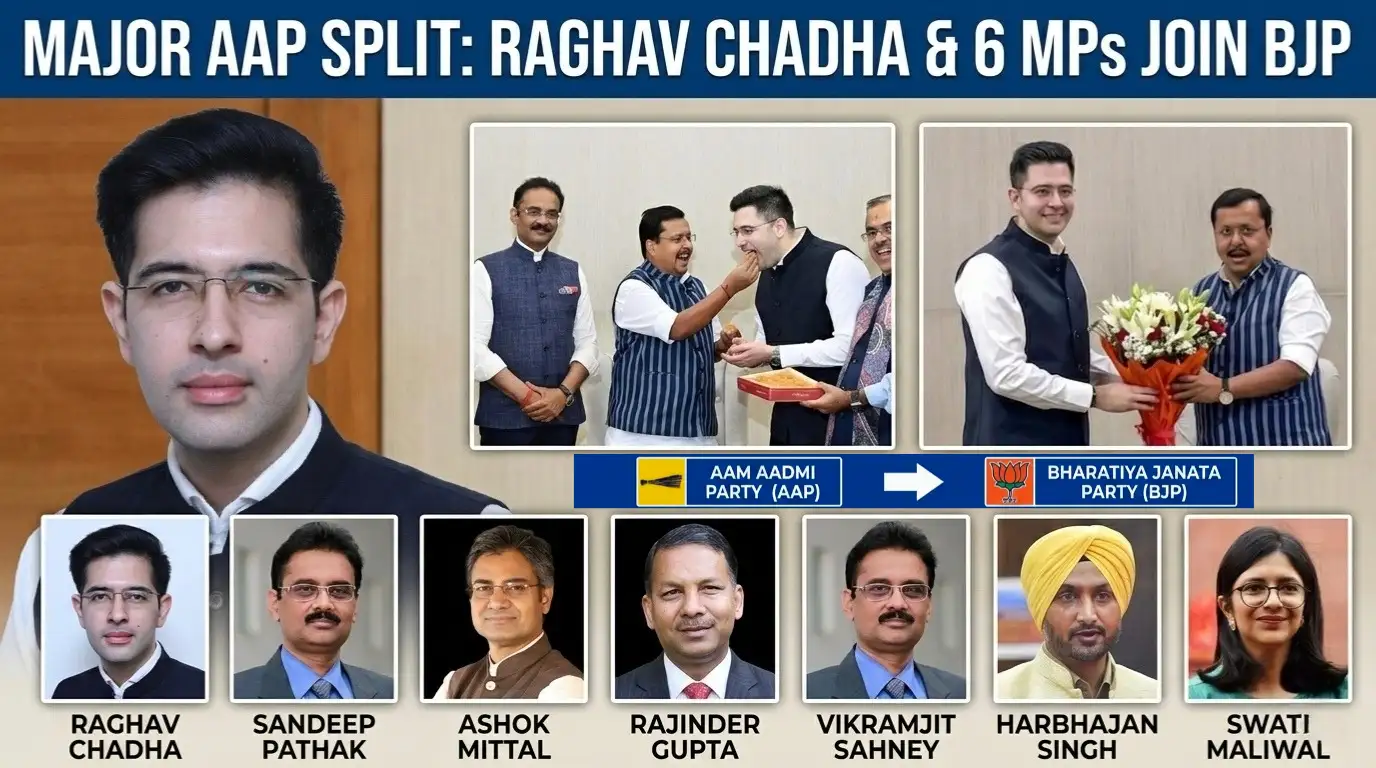
New Delhi, April 24: Raghav Chadha quits AAP and has formally joined the Bhartiya Janta Party along with six Rajya Sabha colleagues, the group announced at a press briefing at the Constitution Club. The defections reduce the Aam Aadmi Party’s strength in the Upper House to three members and mark the most serious AAP Rajya Sabha split since the party’s founding.
“We had just two options — either quit politics and give up our public work in the last 15–16 years, or we do positive politics with our energy and experience,” the group said at the press conference.
The seven MPs who left AAP and joined the BJP are Raghav Chadha, Sandeep Pathak, Ashok Mittal, Rajinder Gupta, Vikramjit Sahney, Harbhajan Singh and Swati Maliwal. Six of the defectors met BJP president Nitin Nabin in the evening; Maliwal announced her decision from Itanagar via social media.
Defectors and reasons cited after Raghav Chadha quits AAP
Party sources said the decision followed months of internal disagreement. According to the defectors, Raghav Chadha quits AAP because he could not reconcile with what he described as ethical and organisational lapses within the party. Chadha, who served as AAP’s deputy leader in the Rajya Sabha, told reporters the move was taken to preserve their public work and political careers.
Swati Maliwal, who had been publicly estranged from AAP since an altercation at a party leader’s residence in 2024, cited allegations of corruption and harassment in her social‑media statement announcing the switch. Sandeep Pathak, an IIT professor who took on central organisational responsibilities during Arvind Kejriwal’s legal troubles, and Ashok Mittal, a Jalandhar industrialist recently elevated to a leadership role in the Rajya Sabha, also said they had lost confidence in the party’s direction.
Insiders said the departures reflected long‑running tensions over leadership style, resource allocation and candidate selection. Observers noted that when Raghav Chadha quits AAP, the defectors framed the decision as principled rather than purely tactical.
BJP response after Raghav Chadha quits AAP
The BJP welcomed the defectors at its headquarters. In a post on X, party president Nitin Nabin extended a formal welcome and described the entrants as assets who would strengthen the party’s organisational capacity. The BJP emphasised the practical advantages of adding experienced organisers and donors, and highlighted the public recognition that figures such as Harbhajan Singh bring.
BJP strategists said they would evaluate roles for the new entrants in organisational and electoral work, particularly in states where the party seeks to expand its presence. Party officials noted that Raghav Chadha quits AAP and joins BJP would be used in messaging to underline the BJP’s ability to attract leaders from other parties.
Impact on AAP’s parliamentary strength and organisation after Raghav Chadha quits AAP
The arithmetic is immediate and stark. With these departures, the AAP Rajya Sabha split leaves the party with only three MPs in each House of Parliament. Beyond the numerical loss, the exits remove several figures who played operational and financial roles within the party.
Analysts identify three principal consequences. First, the loss of organisational capacity: Sandeep Pathak’s exit deprives AAP of a key strategist who managed party operations during crises. Second, financial strain: the departure of business‑linked MPs reduces donor networks that helped fund election campaigns. Third, perception and morale: high‑profile exits, including a national face like Chadha, damage the party’s image of internal cohesion.
Multiple commentators observed that when Raghav Chadha quits AAP, the party loses both a public profile and a connector to national networks. AAP officials acknowledged the immediate challenge of shoring up organisational gaps and rebuilding donor confidence.
Legal questions after Raghav Chadha quits AAP: anti‑defection law India
The legal issue at the centre of the realignment is whether the defections constitute a valid merger under the Tenth Schedule or whether they amount to disqualifiable defection. AAP’s Rajya Sabha leader Sanjay Singh said the party would petition the Chair to disqualify Chadha, Pathak and Mittal under Schedule 10.
The defectors contend that Raghav Chadha quits AAP and that, because two‑thirds of AAP’s Rajya Sabha members have joined the BJP, the merger exemption in Paragraph 4 of the Tenth Schedule applies. Legal scholars caution that the exemption is not a simple arithmetic test. The anti‑defection law India distinguishes between a legislature party and the original political party; the Supreme Court’s 2023 Subhash Desai judgment emphasised that a legislative faction cannot unilaterally declare a merger that purports to represent the national party.
Constitutional experts say the Rajya Sabha Chair will need to examine whether the move originated with the party organisation or with a legislative subset. If the Chair accepts the merger claim, the defectors will retain their seats; if not, they may face disqualification and potential by‑elections. Observers note that the case could prompt renewed calls for legislative amendment to tighten the merger exception and prevent its misuse.
Implications for Punjab and the 2027 assembly elections after Raghav Chadha quits AAP
The defections carry particular weight for Punjab, where AAP currently governs and where assembly elections are due in 2027. Analysts identify several channels through which the split could affect the state contest.
Strategic capacity is one concern: the loss of Pathak and other organisers weakens AAP’s campaign planning and ground coordination. Funding is another: the departure of donor‑linked MPs may reduce resources available for candidate selection, local campaigning and voter outreach. Voter perception is a third factor: high‑profile exits framed around allegations of corruption and internal misconduct could erode AAP’s anti‑establishment appeal among swing voters.
For the BJP, the gains offer an opportunity to build local credibility and expand organisational reach. But observers caution that converting defections into electoral advantage requires sustained local work; symbolic additions alone do not guarantee votes. Several analysts pointed out that Raghav Chadha quits AAP will be used in political narratives in Punjab, but its electoral effect will depend on how both parties mobilise on the ground.
Parliamentary procedure and political next steps after Raghav Chadha quits AAP
Procedurally, AAP is expected to move quickly to seek disqualification of the defectors under the Tenth Schedule. The Rajya Sabha Chair will have to consider the petition and determine whether the merger claim satisfies constitutional and judicially interpreted requirements. Any adverse ruling for the defectors could lead to by‑elections or other parliamentary consequences; a ruling in their favour could set a precedent for similar moves in other parties.
Politically, both parties will recalibrate. AAP must shore up organisational gaps and reassure its base; the BJP will integrate the new entrants and test how best to leverage their public profiles and networks ahead of the 2027 state polls. Observers say that Raghav Chadha quits AAP will remain a reference point in political coverage and campaign messaging in the months ahead.
Conclusion
The departure of Raghav Chadha and six Rajya Sabha colleagues represents a consequential realignment in national politics. Whether the move proves a tactical gain for the BJP or a legal and political setback for the defectors will depend on the Rajya Sabha Chair’s ruling and any subsequent judicial review. The Punjab elections 2027 impact of this split will be watched closely by parties and analysts alike as both sides prepare for the next electoral cycle.
‘Article source- The Telegraph, Times of India, LiveLaw