


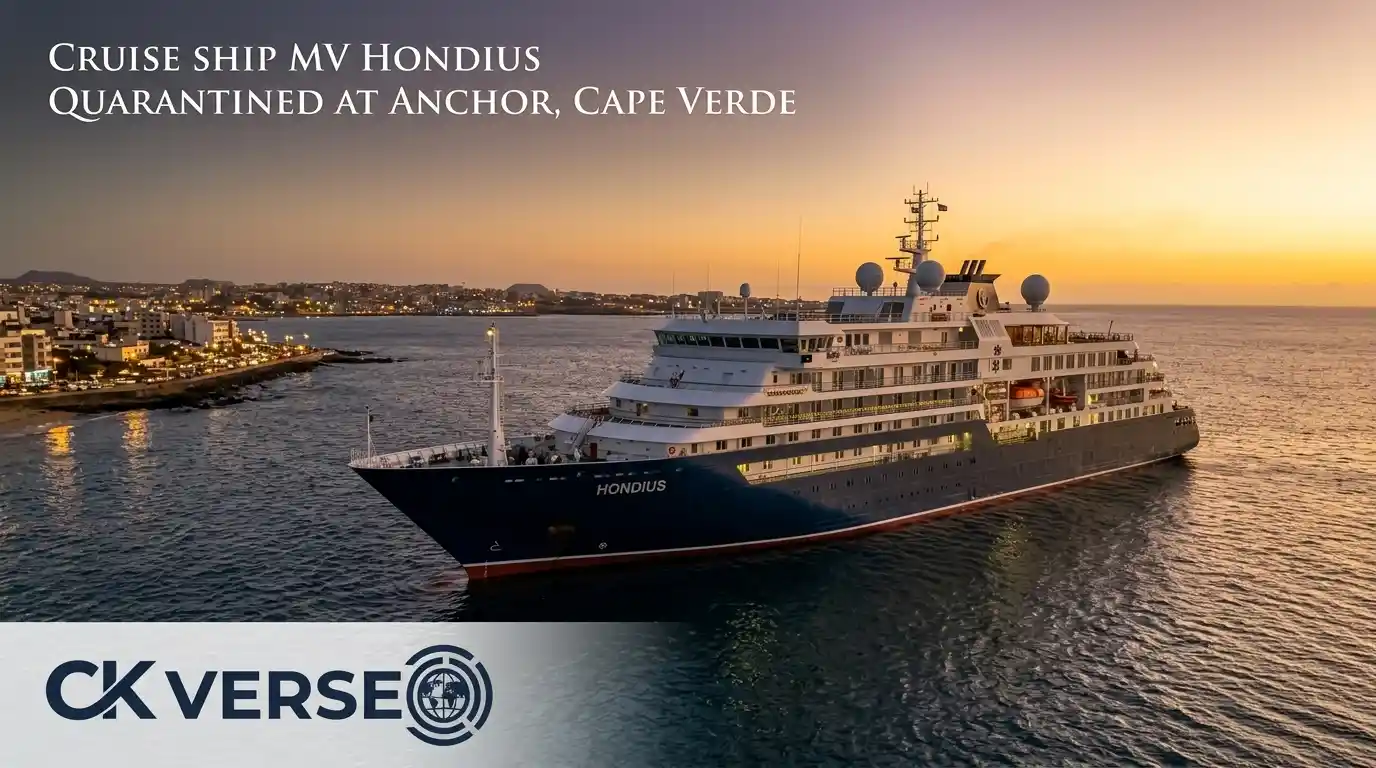
3 passengers are dead and 149 others remain stranded at sea as the MV Hondius hantavirus outbreak continues to unfold off Cape Verde. The luxury expedition cruise ship, operated by Oceanwide Expeditions, has been denied docking permission while the WHO monitors two confirmed and five suspected hantavirus cases. Get the full timeline, symptoms, Andes virus risk, and latest evacuation updates. –>
Quick Facts: At a Glance
| Category | Current Status (May 2026) |
|---|---|
| Vessel | MV Hondius (Oceanwide Expeditions) |
| Fatalities | 3 Confirmed — Dutch couple + German national |
| Total Cases | 2 Lab-Confirmed (PCR), 5 Suspected |
| Location | Anchored off Praia, Cape Verde |
| Suspected Strain | Andes Virus (limited human-to-human spread possible) |
| People On Board | ~149 total — approx. 87 passengers + 61 crew, from 23 countries |
The MV Hondius hantavirus outbreak has left three passengers dead and approximately 149 people — around 87 passengers and 61 crew members from 23 countries — trapped in a floating quarantine off the coast of Cape Verde in the Atlantic Ocean. What began as a premium polar expedition voyage has escalated into one of the most extraordinary maritime health emergencies of modern times, forcing international health agencies, multiple governments, and the World Health Organization to coordinate a response thousands of miles from any major medical facility.
Here is a fully verified, detailed breakdown of every confirmed fact about the MV Hondius hantavirus outbreak — the science behind the virus, the timeline of events, and what comes next.
1. What Is the MV Hondius Hantavirus Outbreak?
The MV Hondius hantavirus outbreak centres on a polar expedition cruise ship operated by Netherlands-based Oceanwide Expeditions. On approximately March 20, 2026, the vessel departed Ushuaia, Argentina, carrying passengers on an extended “Atlantic Odyssey” itinerary — one of the most ambitious expedition routes available to civilian travelers.
2. Confirmed Deaths, Cases, and Current Status
As of May 5, 2026, the following details have been officially confirmed by Oceanwide Expeditions, the WHO, and multiple international news outlets in connection with the MV Hondius hantavirus outbreak:
- Three passengers have died — a 70-year-old Dutch man, his 69-year-old wife, and a German national
- Two cases confirmed via PCR laboratory testing; five additional suspected cases remain under active investigation
- A British passenger is in critical condition in a Johannesburg ICU
- Two crew members — one British, one Dutch — have developed respiratory symptoms and require urgent medical evacuation
- Cape Verde has denied docking at Praia port, citing public health protocols
- ~149 people from 23 countries remain aboard — approximately 87 passengers and 61 crew, including 17 Americans
Note
“The risk to the general public remains low, but the situation requires immediate isolation and medical evacuation.” — World Health Organization (WHO), Official Statement, May 2026
3. Full Timeline of the MV Hondius Hantavirus Outbreak
3.1 March 20, 2026 — Departure from Patagonia
The ship set sail from Ushuaia in Argentina’s Patagonia region on approximately March 20, 2026 — an area where the Andes hantavirus strain actively circulates among native rodent populations. Passengers participated in guided shore excursions through dense wilderness terrain. Health investigators now consider this period the most probable window of initial virus exposure that triggered the MV Hondius hantavirus outbreak.
3.2 April 6 — First Symptoms Reported
A 70-year-old Dutch passenger began experiencing high fever, severe headache, and abdominal pain — classic early-stage hantavirus symptoms. Despite onboard medical attention, his condition deteriorated steadily over the following five days.
3.3 April 11 — First Death Confirmed
The Dutch man died aboard the MV Hondius. His body was subsequently taken ashore at Saint Helena. His 69-year-old wife, who had been in continuous close contact with him throughout his illness, soon began displaying identical symptoms — a development that immediately alarmed medical staff, since most hantavirus strains are not transmissible between humans.
3.4 April 27 — Second Death and First PCR Confirmation
The Dutch woman was medically evacuated to South Africa. She collapsed at the airport upon arrival and died. PCR laboratory testing confirmed hantavirus infection, providing investigators with the first definitive diagnosis and formally establishing the MV Hondius hantavirus outbreak as a verified international public health event.
3.5 May 2–3 — Third Fatality and Full Crisis Declaration
A German national died aboard the ship, becoming the third confirmed fatality of the MV Hondius hantavirus outbreak. Oceanwide Expeditions officially acknowledged all three deaths. The maritime emergency had now escalated beyond any comparable precedent in modern cruise travel history.
4. The Science Behind the MV Hondius Hantavirus Outbreak
4.1 What Is Hantavirus and How Does It Spread?
To fully understand the danger posed by the MV Hondius hantavirus outbreak, it is essential to understand the biology of the pathogen involved. Hantaviruses are zoonotic pathogens — viruses that jump from animals to humans. They are primarily transmitted when humans inhale microscopic aerosolized particles from the urine, droppings, or saliva of infected rodents.
In the Americas, hantavirus infection typically causes Hantavirus Pulmonary Syndrome (HPS) — a condition that can escalate from mild flu-like symptoms to fatal respiratory failure within days.
Early symptoms (appearing 1 to 8 weeks after exposure):
- High fever and intense chills
- Severe muscle aches — particularly in the back, hips, and thighs
- Persistent headache and dizziness
- Nausea, vomiting, and diarrhea
Late-stage progression:
- Dry, persistent cough
- Shortness of breath worsening rapidly
- Fluid accumulation in the lungs
- Circulatory shock and multi-organ failure
There is no specific antiviral cure for hantavirus. Treatment is entirely supportive — oxygen therapy, mechanical ventilation, fluid management, and intensive care monitoring. The case fatality rate for untreated HPS can reach 38% or higher, which explains the urgency surrounding every confirmed case in the MV Hondius hantavirus outbreak.
4.2 Human-to-Human Spread: The Dangerous Reality of the Andes Strain
This is the single most alarming dimension of the MV Hondius hantavirus outbreak for public health officials worldwide.
Nearly every known hantavirus strain cannot spread between humans. The Andes virus — the strain endemic to Argentina and Chile and the primary suspect in this case — is the sole documented exception. Scientists studying previous Andes virus outbreaks in South America have confirmed limited person-to-person transmission, particularly in households and close-contact environments.
A cruise ship presents nearly ideal conditions for such spread: shared ventilation systems, communal dining areas, narrow corridors, and small cabin spaces. The fact that two crew members — who were not part of the original exposed passenger group — have now developed respiratory symptoms adds weight to the human-to-human transmission hypothesis, though investigators have not yet confirmed this as the primary mode of spread within this outbreak.
4.3 Why Patagonia Is the Primary Exposure Site
The long-tailed pygmy rice mouse (Oligoryzomys longicaudatus) is the primary animal reservoir for the Andes virus in Patagonia. Expedition passengers frequently walk through grasslands, coastal scrubland, and forested terrain where these rodents are active. Disturbing dried droppings or nesting material — even briefly, without protective equipment — is sufficient to trigger airborne exposure.
No rodent infestation has been found aboard the MV Hondius itself, which strongly supports the conclusion that exposure in the MV Hondius hantavirus outbreak began on land — before boarding or during shore excursions — rather than within the vessel.
5. Response and Safety Measures Onboard
5.1 Isolation Protocols Implemented by Oceanwide Expeditions
Following the escalation of the MV Hondius hantavirus outbreak, Oceanwide Expeditions implemented a comprehensive onboard emergency response:
- Full cabin isolation for all symptomatic passengers and crew
- Enhanced deep-cleaning and disinfection of all shared spaces, surfaces, and medical areas
- Continuous symptom monitoring for all remaining individuals on board
- Active coordination with Dutch, British, German, and American diplomatic authorities
- Transparent, regular communication with passengers, crew families, and international media
Note
“We are doing everything within our capacity to support the health and safety of everyone on board. We are working closely with international health authorities and remain fully committed to transparency.” — Oceanwide Expeditions, Official Statement, May 2026
5.2 Medical Evacuation Plans: Spain’s Canary Islands and South Africa
Spain’s Canary Islands and South Africa are the two primary destinations under active consideration for medical evacuations from the MV Hondius hantavirus outbreak response zone. The British passenger now fighting for life in a Johannesburg ICU was among the first to be successfully transferred off the vessel.
For the two symptomatic crew members, specialized respiratory care facilities in the Canary Islands represent the most logistically viable near-term option. Dutch health authorities are coordinating directly with Spanish counterparts to facilitate transfers, as the ship remains anchored in international waters off Cape Verde with port access denied.
6. International Response: WHO, Governments, and Cape Verde
Cape Verde’s Health Ministry has held firm on its decision to deny docking, citing internationally recognized protocols for managing potential zoonotic outbreaks at port. This decision, while difficult for the 149 people stranded aboard, reflects standard containment procedure for a virus as unpredictable as the one driving the MV Hondius hantavirus outbreak.
The WHO is actively conducting virus sequencing, contact tracing, and laboratory analysis to map the full scope of the outbreak. Governments including the Netherlands, United Kingdom, Germany, and the United States have activated consular support for their nationals aboard the ship.
The WHO has reiterated that the MV Hondius hantavirus outbreak, while serious and highly unusual, does not represent a broad public health threat. Hantavirus requires specific exposure conditions to spread and is not airborne in the way influenza or respiratory viruses are.
7. What the MV Hondius Hantavirus Outbreak Means for Expedition Cruise Travel
The MV Hondius hantavirus outbreak has exposed a significant gap in how the expedition cruise industry assesses and communicates zoonotic disease risk. Unlike conventional cruise ships — which routinely plan for norovirus or respiratory illness outbreaks — expedition vessels regularly place passengers in direct contact with remote ecosystems where dangerous pathogens actively circulate.
The industry will now face new pressure to implement:
- Pre-excursion health briefings covering local zoonotic risks specific to each destination
- Protective equipment standards for all wilderness shore excursions
- Onboard rapid diagnostic capabilities for a wider range of pathogens
- Robust rodent-contact protocols at remote island stops and South American ports
For travelers, the MV Hondius hantavirus outbreak is a sobering reminder that adventure travel carries real biological risk — and that luxury does not equal immunity.
Is the hantavirus on MV Hondius contagious between passengers?
Most hantavirus strains do not spread between humans. However, the Andes virus — the strain suspected in the MV Hondius hantavirus outbreak — is a documented exception capable of limited person-to-person transmission in close-contact environments. This is why strict isolation protocols have been enforced aboard the vessel since the crisis began.
Where did the MV Hondius hantavirus outbreak originate?
Health investigators believe the initial exposure occurred during land excursions in or around Ushuaia, Argentina — a region where the Andes hantavirus is endemic among native rodent populations, particularly the long-tailed pygmy rice mouse (Oligoryzomys longicaudatus).
What hantavirus symptoms should travelers watch for?
Early symptoms include high fever, severe muscle aches (especially in the back and thighs), fatigue, and gastrointestinal distress. These can progress rapidly to coughing, shortness of breath, and life-threatening respiratory failure. Anyone who recently visited Patagonia and develops these symptoms should seek emergency medical care immediately and disclose their full travel history to doctors.
Conclusion
The MV Hondius hantavirus outbreak stands as one of the most extraordinary convergences of remote wilderness travel, a rarely transmitted virus, and a complex international rescue operation in recent maritime history. With three confirmed deaths, critical cases still unresolved, and 149 people awaiting safe disembarkation, this crisis remains active and evolving.
Sources: BBC News, The New York Times, Reuters, WHO Official Statements, Oceanwide Expeditions Updates — verified as of May 5, 2026. This is a developing situation; always confirm details with primary sources before republishing.