


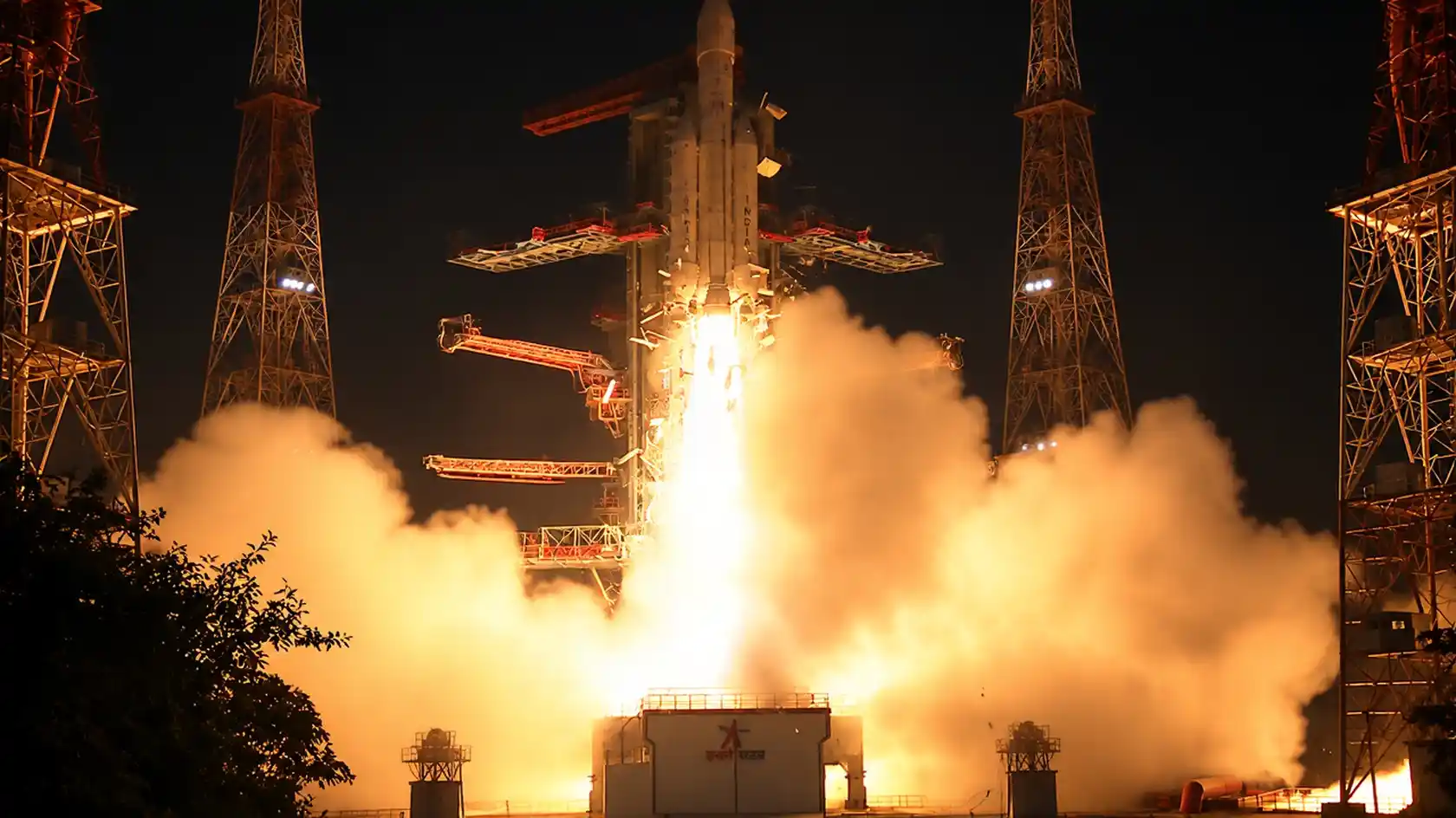
The Indian Space Research Organisation carried out the ISRO EOS-05 satellite launch in the early hours of Friday, sending its GSLV-F17 rocket aloft from the Satish Dhawan Space Centre in Sriharikota, Andhra Pradesh. The rocket lifted off at 2:55 am IST in a pre-dawn operation, and within minutes, ISRO confirmed that EOS-05 had been placed into its intended sub-geosynchronous transfer orbit.
The launch was ISRO’s latest outing for its Geosynchronous Satellite Launch Vehicle, one of the agency’s heavier-lift rockets, and it carried EOS-05, an Earth observation satellite that ISRO has also referred to as its Geo-Imaging Satellite. The mission adds a new spacecraft to India’s Earth-watching fleet at a time when the space agency is also working through preparations for its human spaceflight programme.
READ MORE- Eiffel Tower Strike: Workers Protest Sidelining of Female Staff During Hindu Delegation Visit
ISRO EOS-05 Satellite Launch: How the GSLV-F17 Mission Unfolded
Confirming the outcome shortly after launch, ISRO Chief Dr V Narayanan said the vehicle had performed exactly as required. “I am very happy to announce that the GSLV-F17 vehicle has successfully and precisely injected the advanced Earth observation satellite EOS-05, the Geo-Imaging Satellite, into the intended and required orbit,” he said.
The ISRO EOS-05 Satellite Launch used the 51.7-metre-tall GSLV-F17, which had a liftoff mass of 420.5 tonnes. The rocket lifted off from Sriharikota at 2:55 am IST and placed EOS-05 into its intended Sub-Geosynchronous Transfer Orbit, marking another significant mission for ISRO’s heavy-lift launch programme.
GSLV-F17 Mission Director Thomas Kurian said the mission was a moment of great pride and happiness for the team.” He noted that the launch was the Geosynchronous Satellite Launch Vehicle’s 19th flight, and described EOS-05 as “a uniquely configured Earth observation satellite capable of near-real-time imaging.” He added that it is the heaviest payload the GSLV has carried into a GTO or sub-GTO orbit to date.
READ ALSO- Bengaluru CEO Road Rage: 5 Major Details Behind the Apology and Damages
EOS-05: India’s First Imaging Satellite From Geosynchronous Orbit
EOS-05 is designed to give India a continuous watch over the subcontinent from geosynchronous orbit, operating at an altitude of nearly 36,000 kilometres above earth once it reaches its final position. At that altitude, a satellite’s orbital period matches earth’s rotation, letting it hold a fixed vantage point over the same stretch of the planet rather than sweeping across different regions the way satellites in lower orbits do. ISRO has linked this continuous vantage point to EOS-05’s near-real-time imaging role.
Union Minister for Science and Technology Dr Jitendra Singh described EOS-05 as a state-of-the-art Earth observation satellite and India’s first imaging satellite from geosynchronous orbit, with advanced imaging capabilities across visible, infrared, multispectral and hyperspectral bands. These technologies capture information across a wider range of wavelengths than the human eye can see, with hyperspectral imaging offering finer spectral detail than multispectral systems, supporting more detailed Earth observations
ISRO Chief and Union Minister Jitendra Singh React to the Launch
Narayanan’s confirmation of the orbital injection was the first of several reactions from ISRO’s leadership and the government’s science ministry to follow the launch. Kurian reflected on the effort behind the mission after confirming the satellite’s orbital placement. “A launch lasts only a few minutes, but behind those few minutes are months and years of rigorous effort,” he said, a reminder that Friday’s brief pre-dawn window was the product of far longer preparation on the ground.
Jitendra Singh shared his reaction to the ISRO EOS-05 satellite launch on X soon after liftoff, calling it “another giant leap for India in Space” and offering “kudos to Team @isro on the successful launch of GSLV-F17/EOS-05.” In separate remarks, the minister said India’s space capabilities continue to scale new heights, a trend he linked to the country’s growing standing as a global space power. Taken together, the responses from ISRO’s leadership and the government’s science ministry underscored both the technical significance of the launch and its place within India’s wider space ambitions.
ISRO Gaganyaan Update and the Road Ahead
Narayanan also used his remarks to update the status of India’s Gaganyaan programme. Work on the first uncrewed Gaganyaan mission is proceeding “vigorously and systematically,” he said, with the launch still targeted within this calendar year. The update came in the same post-launch remarks in which he discussed EOS-05, reflecting how closely ISRO’s Earth observation and human spaceflight timelines are now running.
Crediting Prime Minister Narendra Modi’s leadership, Narayanan added that ISRO has six more launches lined up for this financial year, including the NVS-03 navigation satellite, as the organisation moves through a packed run of missions following the GSLV-F17 flight. The pace points to an increasingly busy launch calendar for ISRO, spanning Earth observation, navigation and human spaceflight programmes within the space of a few months.
With the ISRO EOS-05 satellite launch successfully placing the spacecraft into its intended Sub-Geosynchronous Transfer Orbit, EOS-05 will now continue its journey towards its operational geosynchronous position. The mission adds a new capability to India’s Earth observation programme as ISRO simultaneously advances its navigation and human-spaceflight plans.