


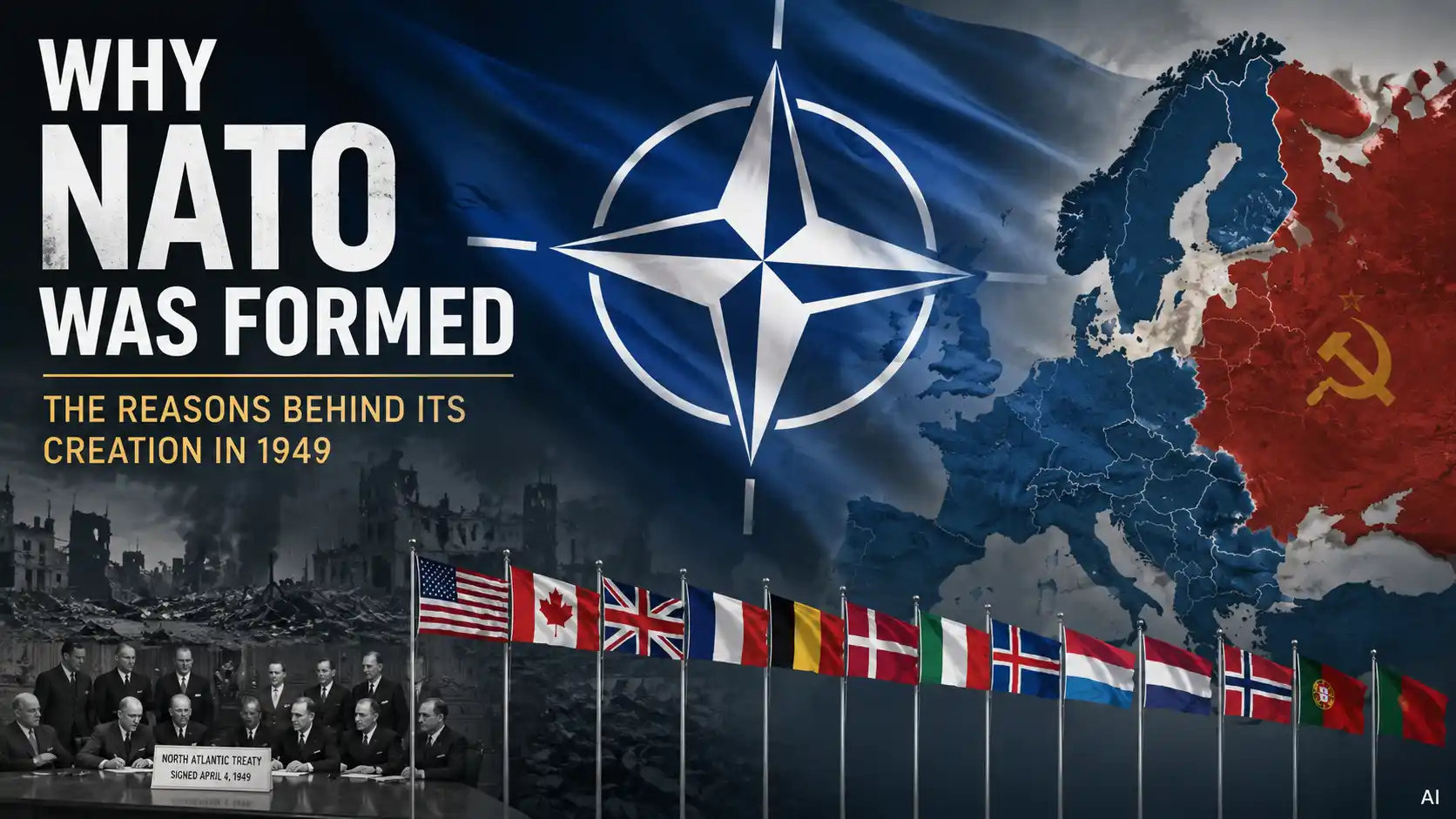
Why NATO was formed comes down to one central problem: after World War II, Western Europe was too weak to defend itself, and the Soviet Union was expanding its influence across Eastern Europe. On April 4, 1949, twelve North American and European countries signed the North Atlantic Treaty in Washington, D.C., creating an alliance built on collective defence. The goal was simple: combine resources so an attack on one member became an attack on all. see this detailed NATO overview.
Why NATO Was Formed
At its core, the alliance existed to solve one problem: Western European countries were too weak, individually, to deter Soviet pressure after 1945, and no single government wanted to face that pressure alone. A collective treaty meant that aggression against one member would be treated as aggression against all of them, which made an attack riskier for any potential opponent. Combined with the military and political weight of the United States and Canada, that commitment gave Western Europe a level of security it could not have built on its own.
Europe After World War II
By 1945, much of Europe lay in ruins. Cities had been bombed, infrastructure was broken, and millions of people had been displaced from their homes. Rationing continued for years afterward, and economies that had once been strong were now struggling to rebuild, let alone fund large militaries.
Political systems were fragile too. Weak governments, economic hardship, and the threat of extremism left several Western European countries worried about their own stability. Without a reliable defence system of their own, these nations had little to fall back on if a stronger power decided to test their borders.
Growing Soviet Influence
Communist governments took power across much of Eastern Europe in the years after the war, often with backing from Moscow. Western leaders grew concerned that Soviet influence would not stop at Eastern Europe’s borders. The February 1948 communist takeover in Czechoslovakia became a turning point.
It happened with covert Soviet support, and it convinced many Western governments that democratic states elsewhere on the continent could face the same fate. This did not mean an invasion of Western Europe was considered certain or already planned. It meant Western governments no longer felt they could ignore the possibility of further Soviet pressure moving westward.
Need for Collective Security
No single Western European government believed it could deter a much stronger neighbour on its own — a gap that explains why NATO was formed. A shared defence arrangement changed the calculation: if several countries committed to defending one another, an attack on any one of them risked pulling in the rest, which made aggression less appealing in the first place.
Belgium, France, Luxembourg, the Netherlands, and the United Kingdom acted on this thinking first, signing the Brussels Treaty in March 1948 and agreeing to assist one another if attacked. It was a meaningful step, but these five countries still lacked the resources to guarantee their own security, and what they needed next was a wider commitment from North America.
The Role of the United States and Canada
That commitment could only come from Washington and Ottawa, and that need is central to why NATO was formed. A lasting guarantee needed the military strength and political weight of the United States and Canada, resources Western Europe could not produce so soon after the war.
Talks expanded beyond the five Brussels Treaty countries to include both governments, and those negotiations became a transatlantic security agreement rather than a purely European one. For the United States, this meant a shift toward permanent peacetime defence cooperation with Europe. For Canada, it meant joining a North American contribution to the wider North Atlantic security effort.
NATO’s Main Purpose
The treaty’s preamble described goals beyond simple defence: safeguarding freedom, protecting democracy and the rule of law, and promoting stability across the North Atlantic region. Deterring Soviet pressure was central to why NATO was formed, but it was not the only reason behind its creation.
The founding members also wanted to prevent a return of the aggressive nationalism that had contributed to two world wars, and they saw value in tying Western European countries together politically as well as militarily. Collective defence was meant to support a stable, cooperative Western Europe, not just counter a single external threat.
Article 5 and Collective Defence
Article 5 is the clause that explains why NATO was formed as a defence pact rather than a looser partnership. It states that an armed attack against one or more members would be treated as an attack against them all. That single sentence worked as a deterrent: any country considering aggression against a NATO member had to weigh the possibility of a combined response from every other member, not just the one attacked.
Article 5 does not require identical action from each country. Members agreed to assist one another by taking whatever steps they judged necessary, which could include armed force but did not have to look the same from one country to the next.
NATO’s Formation in 1949
The North Atlantic Treaty was signed in Washington, D.C., on April 4, 1949, by twelve founding members: Belgium, Canada, Denmark, France, Iceland, Italy, Luxembourg, the Netherlands, Norway, Portugal, the United Kingdom, and the United States. The treaty entered into force on August 24, 1949, once the required ratifications were complete. That gap marks the point where NATO’s formation moved from an agreement on paper to a working alliance with binding obligations.
Why NATO was formed ultimately comes back to a simple set of circumstances: a continent left weak by war, growing concern about Soviet influence pushing further west, and a shared belief that no single country could guarantee its own safety alone. Collective defence, backed by the military and political weight of the United States and Canada, gave Western Europe a security arrangement it could not have built by itself. That combination of postwar vulnerability, Soviet pressure, and the need for a strong transatlantic partner is what led twelve countries to sign the North Atlantic Treaty in 1949.