


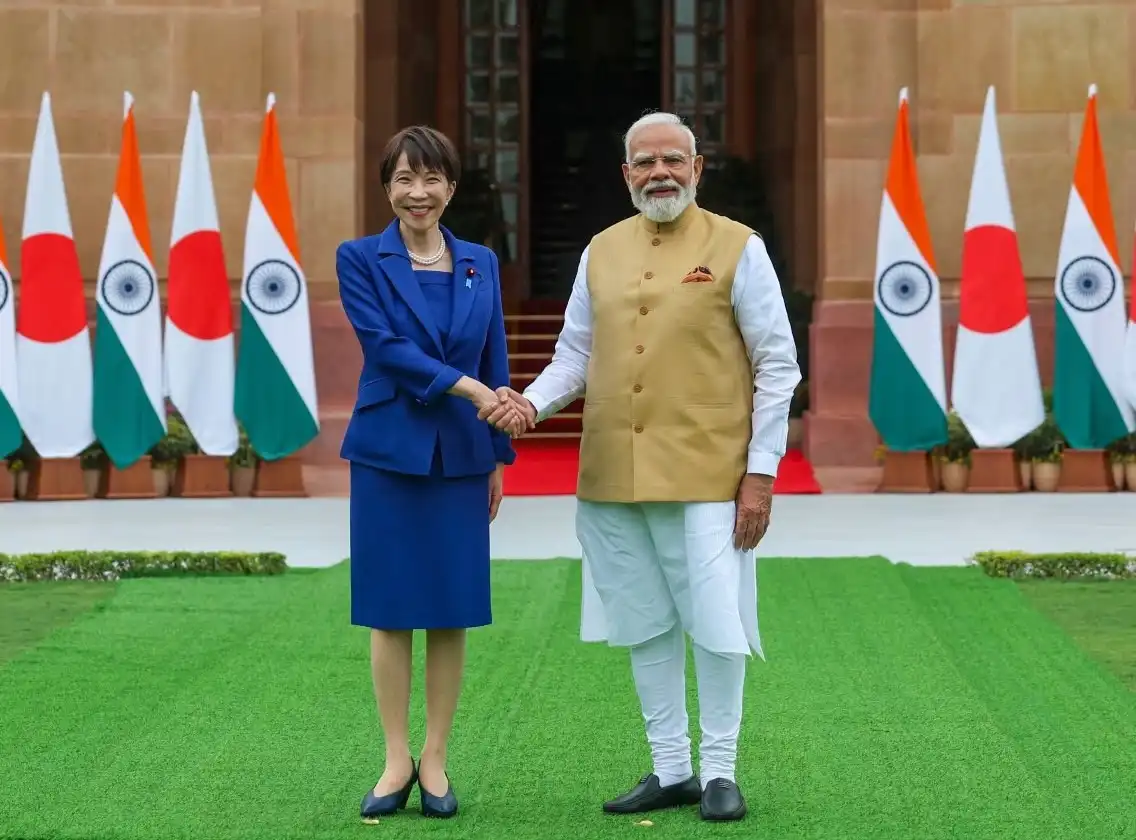
India and Japan concluded the India Japan Summit 2026 in New Delhi on Thursday, signing a series of agreements on artificial intelligence, metals, energy and defence, along with a joint roadmap for economic security. The pacts followed bilateral talks between Prime Minister Narendra Modi and his Japanese counterpart, Sanae Takaichi, who arrived in the capital on Wednesday evening for a three-day visit built around the 16th India Japan Annual Summit.
Speaking to reporters after the talks, Takaichi said the two countries would draw on each other’s strengths to grow together, calling the relationship increasingly important given the turbulent state of world affairs. Modi, in his own remarks, said the coming together of Japan’s precision technology and India’s software capabilities would add fresh momentum to global AI development. Neither leader took questions from the press.
Takaichi’s delegation includes close to 150 business representatives, drawn largely from established sectors such as automotive, banking, finance and insurance, alongside newer areas including semiconductors, batteries, large magnets and clean energy segments like green hydrogen and green ammonia.
India Japan Summit 2026 Focuses on AI, Energy and Economic Security
According to India’s foreign ministry, the two leaders held wide-ranging discussions spanning trade and investment, economic security, energy, emerging technologies, defence and people-to-people exchanges. The ministry said both governments adopted three documents, referred to in its statement as “landmark” texts, covering economic security, energy resilience and artificial intelligence.
The India Japan economic security roadmap is intended to strengthen supply chains so they can better withstand external shocks, a point Indian Ambassador to Japan Nagma Mallick underlined at NDTV’s Indo-Japan Strategic Dialogue. She said the two sides would use their engagements during the visit to deepen economic cooperation while making supply lines more resilient.
India Japan Defence Agreement Marks First Co-Development Project
Modi confirmed that the two countries had signed an agreement covering their first co-development project in the defence sector, a step that extends the relationship beyond its traditional focus on infrastructure and civil technology. India and Japan are both members of the Quad grouping, alongside Australia and the United States, a partnership widely seen as a counterweight to China’s expanding influence across the Indo-Pacific. The new defence pact adds a fresh strand to this wider Quad partnership between the four countries.
India Japan Trade Relations and Investment Figures
The India Japan Summit 2026 also highlighted the growing economic relationship between the two countries, with Indian government data showing bilateral trade reached $27.5 billion in fiscal year 2025-26, while Japanese investment in India stood at $3.2 billion between April and December 2025. These figures build on commitments made during Modi’s visit to Tokyo last year, when Japan pledged to more than double its investment in India to over $61 billion over the following decade.
Japan remains one of India’s largest investors, having backed major infrastructure projects such as the high-speed rail corridor connecting Mumbai and Ahmedabad. Japanese firms have also expanded their presence in Indian companies, including a $1.6 billion deal for a 20 percent stake in Yes Bank. Ambassador Mallick noted that Japan is currently the fourth-largest foreign investor in India, a position built up over decades of steady engagement.
India Japan AI Partnership and Energy Cooperation
The joint statement issued in Delhi described artificial intelligence as a defining technology for the relationship, with the new roadmap covering governance, cybersecurity, chip supply chains and talent mobility. Officials said this cooperation would be aligned with India’s MAHASAGAR outreach initiative and Japan’s revised Free and Open Indo-Pacific strategy, placing the partnership within a broader effort to build resilient, growth-oriented economic networks across the region and the wider Global South.
Read Also- Samsung One UI 9 Beta 4 Release Date Expected on June 30
On the energy side, Modi pointed to a new bio-gas initiative under which the two countries plan to establish 1,000 bio-gas and organic fertilizer plants in India. The project sits within the broader energy resilience document signed during the summit and reflects a shift toward cleaner fuel sources as part of the wider India Japan energy cooperation agenda.
India Japan Business Delegation Eyes Emerging Sectors
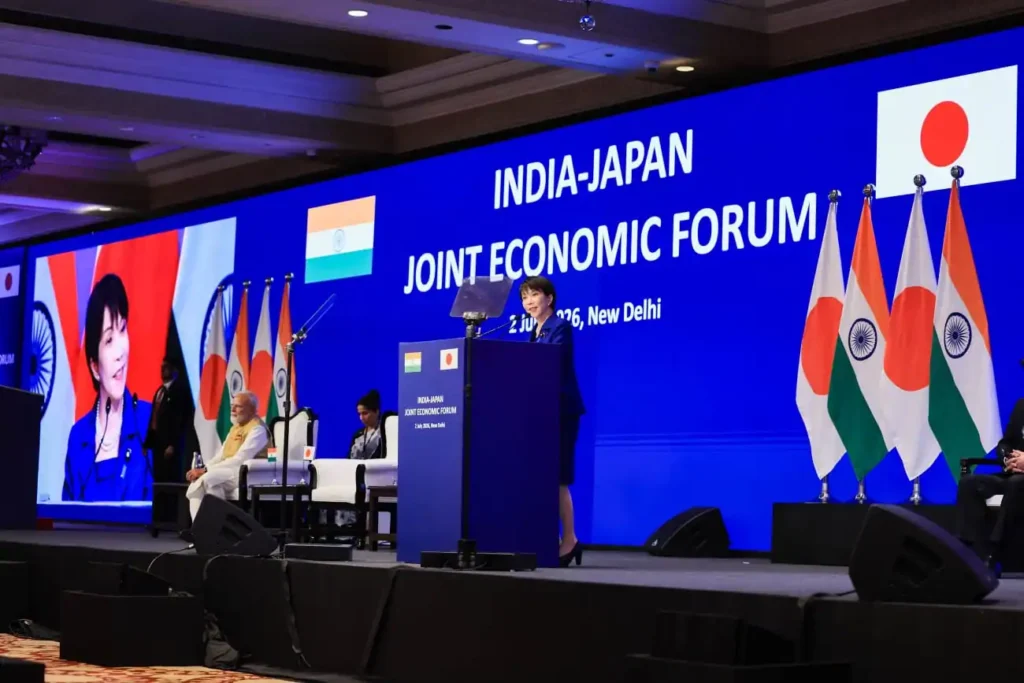
At the India Japan Summit 2026, Ambassador Mallick said the business delegation accompanying Takaichi was expected to announce several new memoranda of understanding, some finalised ahead of the summit and others during the visit. She pointed to semiconductors, batteries, large magnets and clean energy as sectors drawing fresh Japanese interest, alongside the longer-established automotive, banking and insurance ties. Takaichi was scheduled to address a separate business conference later on Thursday, where further details of these agreements were expected.
People-to-People Ties Continue to Support Bilateral Relations
Mallick described India and Japan as democracies with shared values, strong institutions and active civil societies. She said the people-to-people ties between the two nations remain strong, underpinned by shared links of Buddhist heritage that stretch back centuries. The ambassador also traced the personal rapport between the two leaders, noting that Modi and Takaichi had already met on the sidelines of the G20 summit in South Africa last year and the G7 summit in France earlier this year, in addition to Modi’s visit to Japan for the 15th annual summit.
Takaichi, who became Japan’s first woman prime minister after that summit, acknowledged the closeness of the relationship in her own remarks during the visit. Modi, opening his address, greeted her as his “younger sister,” using the Hindi phrase “meri chhoti behen” before switching between Namaskar and Konnichiwa. Takaichi responded in Japanese, saying the talks had confirmed both sides were aligned in developing the relationship as one between siblings.
New Areas Shaping India-Japan Cooperation
The outcomes of the India Japan Summit 2026 point to both governments broadening a relationship that has traditionally centred on infrastructure financing into newer areas such as artificial intelligence, defence co-development and critical minerals. With the business delegation expected to finalise additional agreements and the new energy and AI roadmaps set to guide cooperation over the coming years, officials from both sides framed the visit as setting the direction for the India Japan strategic partnership ahead of future annual summits.