


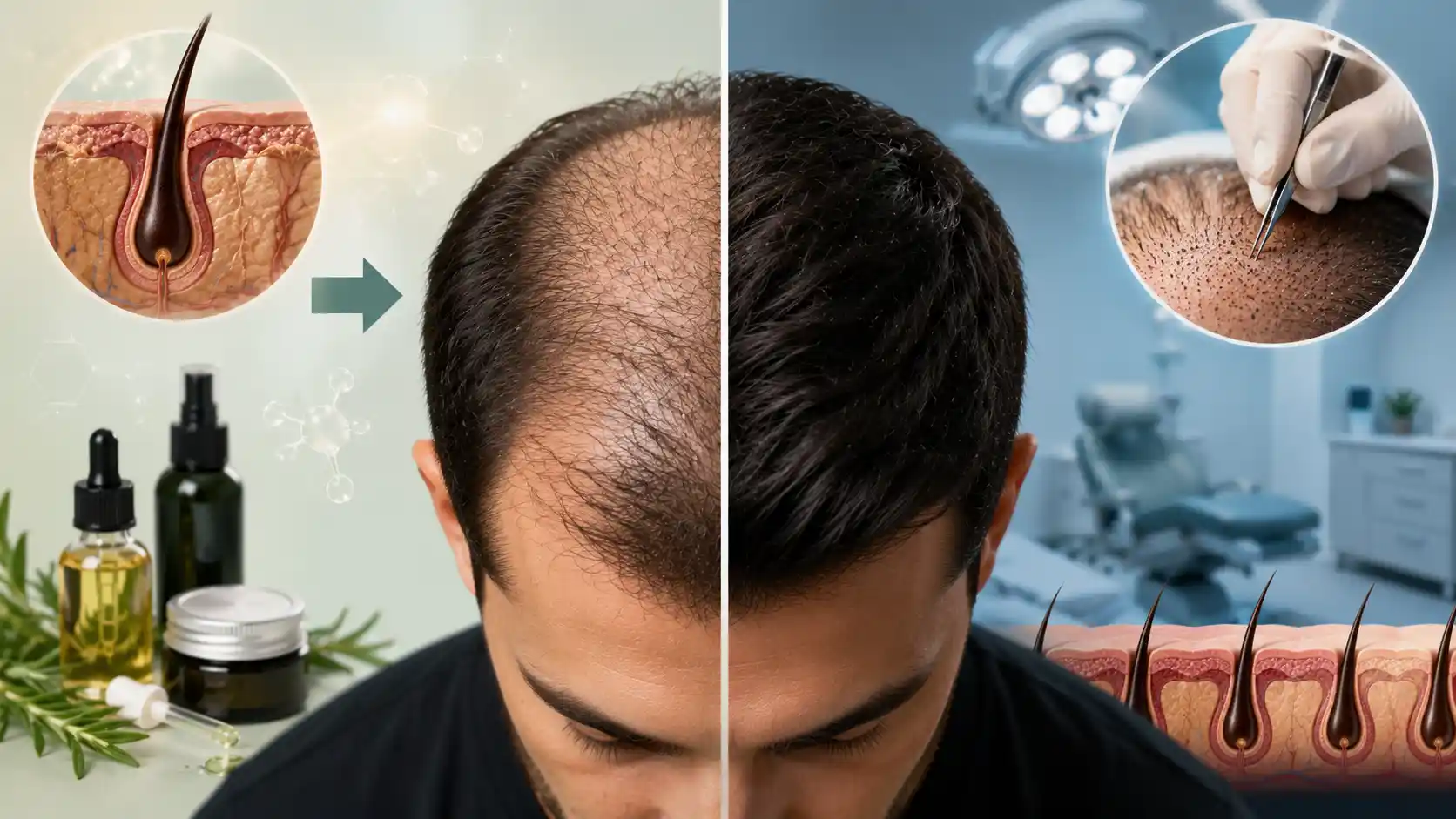
Hair Regrowth vs Hair Transplant brings up one question almost right away: will this come back, or is it gone for good? The honest answer depends on something you can’t see just by looking in the mirror — what’s happening inside the hair follicle itself.
Some hair loss reverses on its own or responds well to medical treatment. Other hair loss doesn’t, and a hair transplant becomes the only realistic way to restore density. This article walks through the biology behind both outcomes, what the evidence actually supports for hair regrowth treatment, and how a hair transplant restores hair when medicine can’t.
Along the way, it also breaks down which treatments have strong clinical evidence behind them, which are still unproven, and how the two main transplant techniques compare — so the choice between hair regrowth treatment and surgery can be based on evidence rather than guesswork.
How Hair Actually Grows
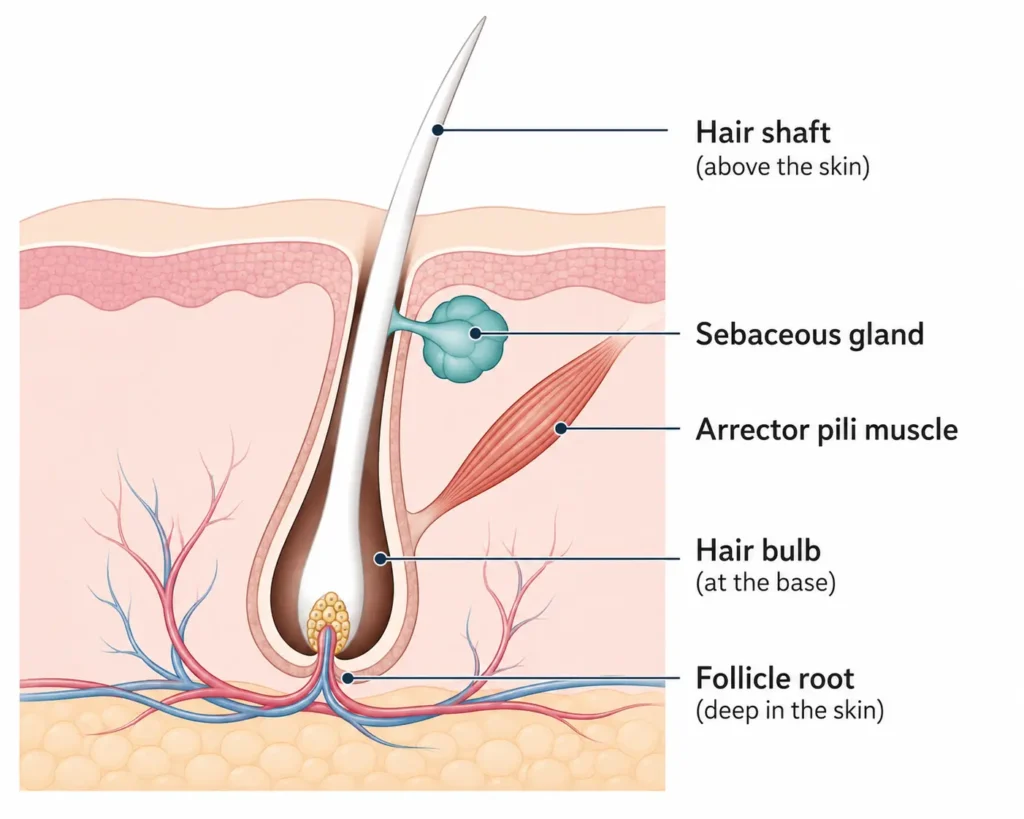
A hair follicle isn’t just a hole that hair grows out of. It’s a small organ in the skin, made up of the follicle structure itself plus a sebaceous gland (the part that makes oil) and a tiny arrector pili muscle, which is what causes goosebumps.
These follicles don’t grow hair just once. They cycle through growth, rest, and shedding, again and again, for most of a person’s life. That repeated cycling is the reason hair can often regrow after many kinds of hair loss, as long as the follicle underneath is still alive.
This leads to one of the most important ideas in hair loss medicine: the follicle can survive even after the visible hair — called the hair shaft — has shed. A person can look thin or bald in a patch of scalp while the follicles underneath are still capable of producing hair again. This is especially true for nonscarring types of hair loss, which we’ll get into shortly.
Understanding the Hair Growth Cycle
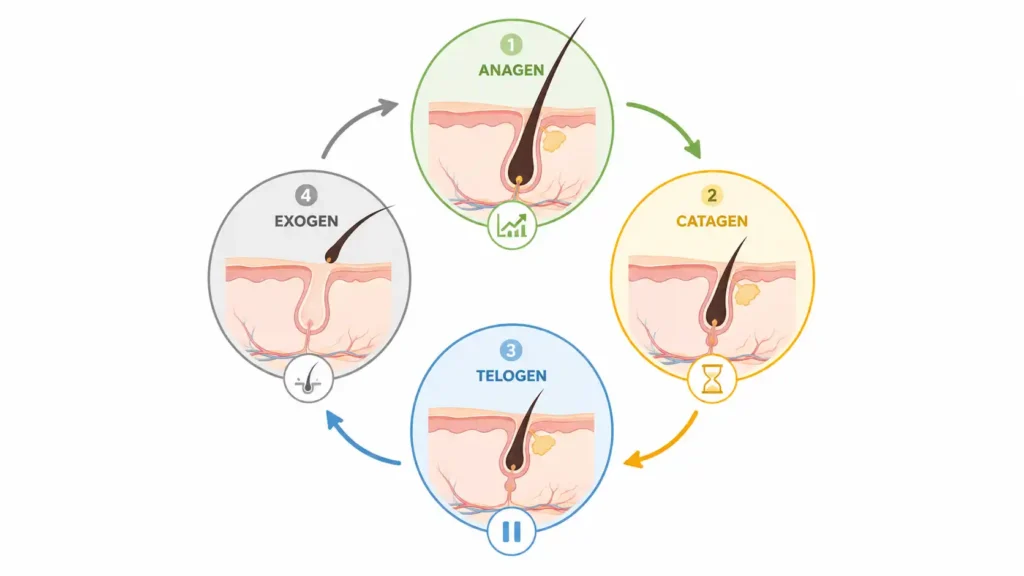
Every hair follicle moves through a cycle with four main stages:
- Anagen — the active growth phase. This is the longest stage, and it decides how long your hair can eventually grow.
- Catagen — a short transition phase where the follicle starts to shrink and pull back.
- Telogen — the resting phase, where the hair isn’t growing but hasn’t fallen out yet.
- Exogen — the shedding phase, when the resting hair (called a club hair, since it has a small club-shaped root) finally releases and falls out.
Some medical reviews also describe a gap called “kenogen,” where the follicle stays empty for a while after a hair sheds before a new one starts growing. For everyday understanding, though, the four-stage cycle above covers what matters most.
And this is why it is entirely normal for some hair to fall out every day. Hair loss itself is not necessarily a problem; rather, it is just a component of the natural hair growth process. The problem arises when the amount is abnormal, if it happens unexpectedly, or it does not stop. And for this reason, doctors are generally less worried about the specific daily amount.
Why Hair Loss Happens: Scarring vs Nonscarring Conditions
Doctors generally split hair loss causes into two big categories: nonscarring and scarring alopecia.
Nonscarring alopecia includes:
- Androgenetic alopecia — commonly known as male pattern baldness in men and female pattern hair loss in women. This is a gradual, progressive shrinking of the hair follicle, known as miniaturization.
- Telogen effluvium — a diffuse, all-over shedding pattern, often triggered by stress, illness, or a change in the body.
- Alopecia areata — an immune-related condition that causes patchy hair loss.
- Trichotillomania — a hair-pulling disorder.
Scarring alopecia includes conditions such as:
- Lichen planopilaris — an inflammatory condition that scars the scalp.
- Frontal fibrosing alopecia — a pattern of scarring along the hairline.
- Discoid lupus erythematosus — an autoimmune condition that can scar the scalp.
- Folliculitis decalvans — an inflammatory condition connected to bacteria that scars hair follicles.
This split matters because it decides whether regrowth is even biologically possible. In nonscarring alopecia, the loss may be reversible once the trigger is corrected, or once the follicle is supported with treatment. Telogen effluvium is a good example of a shed that’s usually temporary. Androgenetic alopecia is different — it’s progressive miniaturization, meaning the follicles are shrinking over time rather than being destroyed outright.
Scarring alopecia works differently. It destroys the follicle itself, which is why it’s much more likely to lead to permanent hair loss.
Knowing which category a person falls into is really the first step toward the right hair loss treatment — not the number of hairs left on the pillow, and not how much scalp is visible in the mirror.
Temporary Hair Loss vs Permanent Hair Loss
Temporary hair loss is more often linked to causes like telogen effluvium, alopecia areata, certain medications, nutritional deficiency, thyroid or other endocrine disease, postpartum shedding after childbirth, illness, or stress-related shedding. In most of these situations, the follicle is still intact. Once the trigger resolves, or once proper treatment is used, the follicle can start producing hair again.
Permanent hair loss is more likely in two situations: when scarring or inflammation has destroyed the follicle, or when long-standing, progressive miniaturization from androgenetic alopecia reaches a point where the follicle is no longer functional.
This distinction also decides who is even a candidate for a hair transplant. Surgeons only consider a transplant when the donor area (where hair is taken from) is stable, and the area being treated isn’t actively inflamed or scarring in a way that would put new grafts at risk.
[Comparison Table]
| Temporary Hair Loss | Permanent Hair Loss | |
|---|---|---|
| Common causes | Telogen effluvium, alopecia areata, medication effects, nutritional deficiency, endocrine disease, postpartum shedding, illness, stress | Scarring or inflammatory alopecia; long-standing, advanced androgenetic alopecia |
| What’s happening to the follicle | Intact, dormant, or miniaturized | Scarred or permanently destroyed |
| Chance of regrowth | Often regrows once the trigger is treated or resolved | Regrowth isn’t expected; a transplant may be an option if donor hair is adequate |
When Hair Can Naturally Grow Back
Can hair grow back naturally? It depends on three things: whether the follicle is still alive, whether the cause behind the hair loss can be reversed, and whether the environment around the follicle — including the stem cells that support new hair growth — is still intact.
If a follicle is dormant or miniaturized, regrowth may still be possible. If it has been scarred or permanently destroyed, it isn’t.
A simple way to think about this: shedding does not equal destruction. Many people with diffuse shedding recover fully once the underlying cause is treated. Long-standing androgenetic alopecia, and any form of scarring alopecia, come with a much lower chance of the hair fully growing back on its own.
Dormant, Miniaturized, or Scarred: What’s Really Happening Inside the Follicle
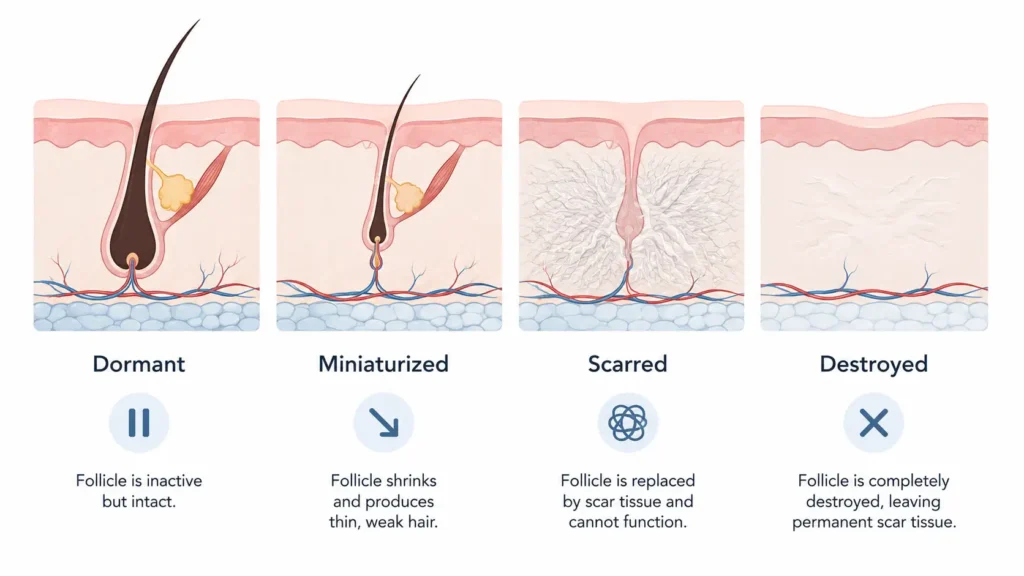
Not all “inactive” follicles are the same. There are meaningful differences between them:
- Dormant follicle — still present, just temporarily inactive. It can re-enter the growth (anagen) phase.
- Miniaturized follicle — still alive, but producing thinner and shorter hairs than before. This is the hallmark of androgenetic alopecia.
- Scarred follicle — replaced or compressed by fibrous scar tissue after inflammation.
- Permanently destroyed follicle — no longer has the biological ability to produce a full, terminal hair.
Two scalps can look almost identical from the outside — thin, patchy, or fully bald — while one still has a real chance at regrowth and the other doesn’t. That difference isn’t visible without a proper scalp exam.
This matters because it marks a real medical threshold. Once a follicle is scarred or destroyed, medication can sometimes slow down further hair loss nearby, but it cannot bring back a follicle that’s already gone. At that point, if the area is otherwise stable and there’s enough donor hair available, surgery may be the only remaining option for a cosmetic fix.
Hair Regrowth Treatments Backed by Science
Not every hair loss treatment has the same level of evidence behind it. Here’s what the research says about each one, rated as Strong, Moderate, Limited, or Insufficient evidence based only on the research reviewed for this article.
Minoxidil
Topical minoxidil has the strongest evidence base of any non-surgical hair regrowth treatment for androgenetic alopecia, and it works in both men and women [8]. A systematic review and meta-analysis found minoxidil performed better than a placebo, though the individual trials varied quite a bit from each other.
Evidence: Strong
Finasteride
Oral finasteride is an established treatment for male pattern baldness, backed by substantial randomized-trial evidence. Comparative research shows it improves hair counts compared to a placebo. It doesn’t work for every person, though, and the benefit needs continued use to be maintained.
Evidence: Strong (in men)
Dutasteride
Dutasteride appears to work at least as well as finasteride, and some comparative research suggests it may be more effective at improving hair count in male androgenetic alopecia. The tradeoff is a similar set of side effects to finasteride, and less research has been done on dutasteride overall.
READ ALSO- Snoopy Glass Cup Starbucks Anchors Worldwide Peanuts Collection for ‘Great Pumpkin’ 60th Anniversary
Evidence: Moderate
Oral Minoxidil
Low-dose oral minoxidil is being used more often off-label (meaning outside its officially approved use) for hair loss. The evidence supporting it is smaller and less developed than for topical minoxidil. It’s a promising option, but it isn’t as well established as topical minoxidil or drugs like finasteride and dutasteride.
Evidence: Moderate
PRP (Platelet-Rich Plasma)
PRP involves injecting a concentrated part of a person’s own blood into the scalp. The evidence for PRP is promising but inconsistent, and study protocols vary a lot — different preparation methods, doses, injection schedules, and ways of measuring success. PRP is best thought of as an add-on treatment right now, not a standalone, first-line hair loss treatment.
Evidence: Moderate (in some settings)
Microneedling
Microneedling uses tiny needles to create controlled micro-injuries in the scalp, which may help other treatments work better. It shows favorable results, especially when combined with minoxidil or PRP, but the overall data quality is still fairly low and inconsistent. It’s currently supported more as an add-on than as a treatment on its own.
Evidence: Moderate (as an adjunct)
Low-Level Laser Therapy
Low-level laser or light therapy (sometimes sold as laser combs or caps) has support from randomized trials and meta-analyses for androgenetic alopecia. The effect sizes tend to be modest, and results vary by device. It’s fair to call this an evidence-based option, but not a dramatic or guaranteed one.
Evidence: Strong
Ketoconazole Shampoo
Ketoconazole shampoo is commonly used alongside other treatments for androgenetic alopecia. It has anti-inflammatory and anti-yeast properties, and possibly some mild antiandrogenic effects, which support general scalp health. High-quality evidence for meaningful hair regrowth on its own is limited compared to minoxidil or finasteride, so it’s best viewed as supportive care rather than a core regrowth therapy.
Evidence: Limited
Hair Supplements
Evidence for routine hair supplements — like biotin, zinc, vitamin D, or iron — is weak unless there’s an actual, diagnosed deficiency. Taking these without a known deficiency generally isn’t supported by research. That said, protein deficiency specifically can contribute to hair shedding.
Evidence: Limited (without a documented deficiency)
[Evidence Rating Table]
| Evidence Level | Treatments |
|---|---|
| Strong | Topical minoxidil; oral finasteride (in men); low-level laser therapy |
| Moderate | Dutasteride; oral minoxidil; microneedling (as an adjunct); PRP (in some settings) |
| Limited | Ketoconazole shampoo; hair supplements without a documented deficiency; rosemary oil; pumpkin seed oil; onion juice |
| Insufficient | Castor oil; aloe vera; caffeine; coconut oil (for regrowth specifically) |
Natural Remedies: What the Evidence Actually Shows
Natural remedies for hair loss are popular, but they don’t carry the same weight of evidence as topical minoxidil or oral finasteride. That doesn’t automatically make them worthless — some may support scalp comfort or the condition of the hair shaft — but it does mean they shouldn’t replace a hair regrowth treatment with stronger clinical support behind it. Here’s how each one holds up.
Rosemary Oil
Rosemary oil has one of the better-known small trials among natural remedies, but the overall evidence is still limited. It’s reasonable to call it promising, low-certainty evidence — not something proven to match standard hair loss treatment.
Onion Juice
Onion juice has small-study support, mostly for patchy alopecia areata, but the evidence is sparse and not strong enough for broad recommendations.
Pumpkin Seed Oil
Some randomized research suggests a possible benefit for androgenetic alopecia, but the trials are small, and the results haven’t been widely repeated.
Coconut Oil
Coconut oil works better as a conditioning agent for the hair shaft than as an actual regrowth treatment. Evidence for it triggering real follicular regrowth is insufficient.
Castor Oil
Castor oil is widely marketed for hair growth, but there isn’t convincing clinical trial evidence that it regrows hair.
Aloe Vera
Aloe vera is often used to soothe the scalp, which supports general scalp health, but the evidence for actual hair regrowth is insufficient.
Caffeine
Caffeine has some appeal based on lab and cell studies, but real-world clinical evidence for meaningful regrowth in people remains limited.
How Hair Transplant Restores Hair
A hair transplant becomes the main effective option once follicles in a balding area are no longer salvageable with medication — most often in stable androgenetic alopecia, where there’s still enough healthy donor hair elsewhere on the scalp [18]. Hair restoration surgery is also used for certain scarring alopecias, but only once the disease is inactive and a surgeon judges the area stable enough to support new grafts.
It’s important to understand what a transplant does and doesn’t do. Hair restoration surgery works mechanically — moving existing, healthy hair from one part of the scalp to another — rather than biologically curing whatever caused the loss in the first place. It is not a cure for ongoing inflammatory disease, poor donor hair supply, or unexplained diffuse shedding. A transplant placed into an area with active disease can fail, or the transplanted hair can be lost over time.
FUE vs FUT: Choosing a Transplant Technique
There are two main hair transplant techniques: FUE and FUT.
- FUE (Follicular Unit Extraction) — individual follicular units are removed from the donor area one at a time.
- FUT (Follicular Unit Transplantation) — a strip of scalp is removed from the donor area and then dissected into individual grafts.
[FUE vs FUT Table]
| Feature | FUE | FUT |
|---|---|---|
| Technique | Individual follicular units extracted one by one | A strip of scalp is removed and divided into grafts |
| Advantages | No linear scar; often a quicker return to short hairstyles | Efficient graft yield; useful for larger sessions; often more cost-effective |
| Disadvantages | More time-consuming; donor area can be overharvested; leaves tiny dot scarring | Leaves a linear donor scar; more post-op tightness; some risk of visible scarring |
| Graft survival | Good in experienced hands, but highly dependent on the surgeon’s technique | Also good; no method has been shown to be universally superior for every patient |
| Recovery | Usually less wound-related discomfort, though the donor area can still be tender | Longer healing time for the strip incision, with more suture and scar care needed |
| Long-term outcomes | Good cosmetic results with appropriate donor selection | Good cosmetic results when performed well and the scar heals acceptably |
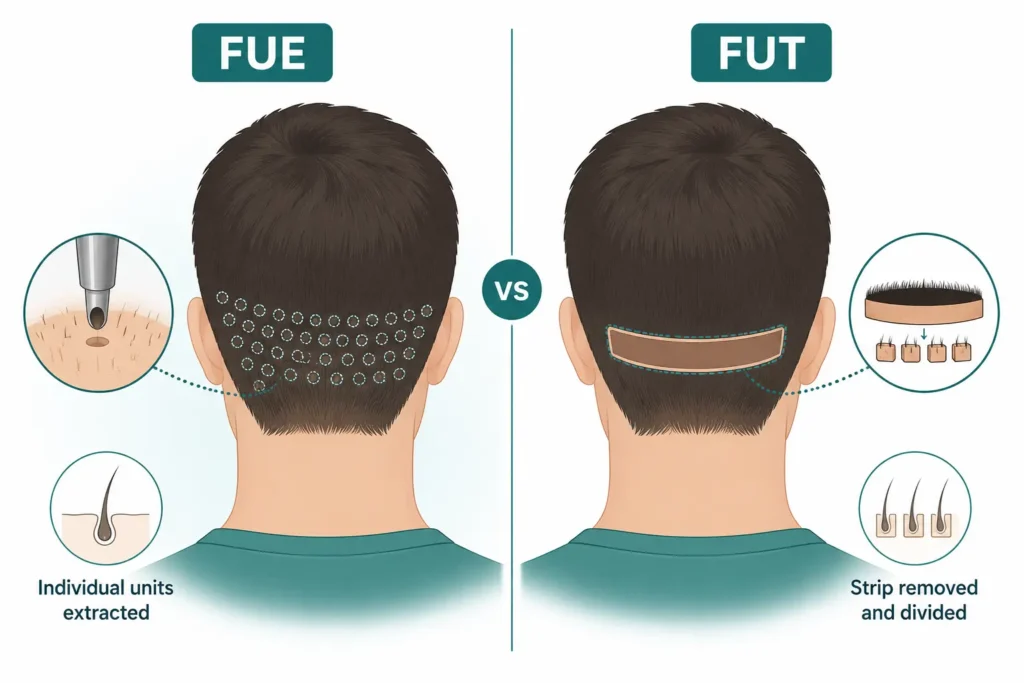
Choosing between FUE and FUT depends on several things: how loose or tight the scalp skin is, hairstyle preferences, how many grafts are needed, the quality of the donor area, the risk of visible scarring, and the surgeon’s own expertise. Most of the research comparing the two is observational and closely tied to technique, rather than large head-to-head randomized trials.
Hair Transplant Recovery Timeline
Hair transplant recovery follows a fairly predictable pattern, though individual healing speed varies.
[Timeline]
| Timepoint | What to Expect |
|---|---|
| 1 week | Redness, crusting, and swelling are common. Wound care is the main focus. |
| 1 month | Transplanted hairs often shed. This is expected and does not mean the transplant failed. |
| 3 months | Early regrowth may start, though density is still limited. |
| 6 months | Visible improvement is common, and the cosmetic change becomes clearer. |
| 12 months | Most patients reach their final or near-final hair transplant results. |
Risks and Side Effects to Know About
Medical treatments carry their own set of possible side effects. These can include local irritation, sexual side effects linked to 5-alpha-reductase inhibitors like finasteride and dutasteride, early shedding when starting minoxidil, and rare systemic effects with oral minoxidil. Supplements aren’t automatically safe either — taking them without a real need can cause harm, and relying on them can delay a proper diagnosis.
Hair transplant surgery carries its own risks, including bleeding, infection, scarring, numbness, swelling, folliculitis (inflamed hair follicles), shock loss (temporary shedding of existing hair near the transplant site), poor growth, and an unnatural appearance if the procedure is planned or performed poorly. These risks are generally low in experienced hands, but they aren’t zero — and because hair restoration is an elective procedure, it’s worth going in with realistic expectations.
Hair Regrowth vs Hair Transplant: A Side-by-Side Comparison
[Comparison Table]
| Factor | Hair Regrowth Treatment | Hair Transplant |
|---|---|---|
| Best suited for | Nonscarring, reversible hair loss, or early androgenetic alopecia with viable, miniaturized follicles | Stable androgenetic alopecia with unsalvageable follicles and enough donor hair; inactive scarring alopecia once controlled |
| How it works | Supports or stimulates follicles that are dormant or miniaturized | Relocates healthy follicles from a donor area to a balding area |
| Strongest evidence | Topical minoxidil, oral finasteride (men), low-level laser therapy | Generally good graft survival in experienced hands, though outcomes vary by technique, surgeon, and underlying condition |
| Timeline | Ongoing; results depend on continued treatment | Early regrowth around 3 months; visible results by 6 months; final results by around 12 months |
| Effect on underlying disease | Can directly treat reversible triggers; AGA drugs may slow further miniaturization | Does not stop or cure the underlying disease process |
| Key risks | Local irritation, sexual side effects (5-alpha-reductase inhibitors), early shedding | Bleeding, infection, scarring, numbness, shock loss, unnatural results if poorly performed |
Who Should Choose Which Treatment
Hair regrowth treatment tends to make the most sense when the hair loss is nonscarring and reversible. That includes telogen effluvium, early alopecia areata, some medication-related hair loss, and early androgenetic alopecia where the follicles are still alive but miniaturized. In these situations, treating the underlying trigger, or using an evidence-based medical therapy, can lead to partial or even substantial recovery.
In practice, this means two people with a similar amount of visible thinning can need completely different plans. One may respond well to topical minoxidil or oral finasteride, while the other may already be past the point where medication alone can help — because their follicles, not just their hair, are in a different state.
A hair transplant becomes the more realistic choice when the hair loss is long-standing, severe, or the result of scarring. In these cases, medical treatment may help stabilize the hair that remains, but a full return to the original density on its own is unlikely [6]. A transplant is most appropriate for stable androgenetic alopecia with a healthy donor area, or for scarring alopecia that has been inactive long enough for a surgeon to consider it safe for grafting.
The right path always depends on a proper diagnosis — how long the hair loss has lasted, its pattern, what a scalp exam shows, and whether there’s any sign of scarring or active inflammation.
Common Hair Growth Myths, Explained
[Myth vs Fact Box]
| Myth | Fact |
|---|---|
| If hair falls out, the follicle is dead. | Many follicles are still alive in nonscarring alopecia and can regrow hair later [6]. |
| Natural oils work just as well as minoxidil. | The evidence for most natural remedies is far weaker than the evidence for minoxidil [16]. |
| A hair transplant stops ongoing hair loss. | A transplant relocates follicles — it doesn’t stop the disease process causing hair loss elsewhere [18]. |
| Shedding after a transplant means it failed. | Early shedding around one month is expected before new growth begins [19]. |
What the Numbers Actually Show
Androgenetic alopecia is the most common cause of progressive, pattern-based hair loss, and hair loss in general is common enough to be a significant quality-of-life issue in both dermatology and general medicine. Telogen effluvium is also common, and it’s often reversible once the trigger behind it is identified and addressed.
For hair transplant surgery, systematic reviews of modern techniques generally show good graft survival and low complication rates when performed by experienced surgeons. That said, reported outcomes vary quite a bit depending on the technique used, the surgeon, the underlying condition, and how each study was designed. One systematic review looking at inactive scarring alopecia (technically called primary cicatricial alopecia) found that graft survival peaked around the one-year mark and then declined with longer follow-up — a reminder that keeping the underlying disease under control matters just as much as the surgery itself.
What Current Medical Guidelines Say
Hair loss treatment recommendations are guided by ongoing clinical research and professional society guidelines, not fixed rules. Some of the most relevant recent updates include the British Association of Dermatologists’ living guideline for managing alopecia areata, published in 2024/2025, which represents a major evidence-based update.
The BAD’s earlier 2012 guideline on alopecia areata management is also part of this body of work. The Japanese Dermatological Association released its own Clinical Practice Guidelines for Alopecia Areata in 2024, adding useful international context.
On the surgical side, the International Society of Hair Restoration Surgery (ISHRS) publishes clinical practice guidance and position statements, including guidance specific to FUT and FUE techniques.
For simpler, patient-facing explanations, resources from the NHS, Mayo Clinic, and Cleveland Clinic are useful starting points, though the core evidence-based claims in hair loss medicine rely mainly on systematic reviews, randomized trials, and these kinds of society guidelines.
For readers, the practical takeaway is that hair loss treatment isn’t guesswork. It’s shaped by ongoing research from dermatology and hair restoration bodies around the world, from national guideline groups in the UK and Japan to surgical organizations like the ISHRS.
Questions People Often Ask About Hair Regrowth
Will my hair grow back on its own?
It depends on the cause. Nonscarring, reversible hair loss — like telogen effluvium or early alopecia areata — often improves once the trigger is treated. Long-standing or scarring hair loss is much less likely to reverse on its own. This is also why a proper scalp exam matters more than judging things by eye — two patches of thinning that look similar on the surface can have very different outcomes.
How do I know if my hair loss is temporary or permanent?
A proper evaluation looks at how long the hair loss has lasted, its pattern, a scalp exam, and whether there’s any scarring or active inflammation. That combination usually points to a diagnosis.
What’s the difference between scarring and nonscarring hair loss?
Scarring alopecia destroys the hair follicle permanently. Nonscarring alopecia leaves the follicle intact, dormant, or miniaturized, which means regrowth is often still possible.
Can a dormant hair follicle come back to life?
Yes. A dormant follicle is inactive, not dead, and it can re-enter the growth phase. A scarred or permanently destroyed follicle cannot.
What is androgenetic alopecia?
It’s the medical term for male pattern baldness in men and female pattern hair loss in women. It involves the gradual miniaturization of hair follicles rather than sudden destruction.
Does minoxidil work for female pattern hair loss too?
Yes. Topical minoxidil is effective in both men and women and has the strongest evidence base among non-surgical hair regrowth treatments.
Do I have to keep taking finasteride to keep my results?
Based on the evidence, yes — finasteride’s benefit needs to be maintained with continued use, and it doesn’t work for everyone.
Is finasteride safe for everyone?
No treatment is risk-free. Finasteride belongs to a drug class (5-alpha-reductase inhibitors) linked to possible sexual side effects, so it’s worth discussing personal risk with a doctor.
Is dutasteride better than finasteride?
Some comparative research suggests dutasteride may improve hair count more than finasteride, but it has a smaller evidence base and a similar side-effect profile.
Does low-dose oral minoxidil work as well as the topical version?
It’s increasingly used off-label and shows promise, but the evidence behind it is smaller and less developed than for topical minoxidil.
Is PRP effective for hair loss?
The evidence is promising but inconsistent, largely because study methods vary so much. PRP currently works best as an add-on rather than a standalone treatment.
Does microneedling regrow hair by itself?
The current evidence supports microneedling more as an add-on to minoxidil or PRP than as a stand-alone hair regrowth treatment.
Is low-level laser therapy backed by real evidence?
Yes, it has support from randomized trials and meta-analyses for androgenetic alopecia, although the effect is generally modest rather than dramatic.
Do hair supplements like biotin actually help?
Only if there’s a real, diagnosed deficiency. Taking supplements without one has weak supporting evidence, though protein deficiency specifically can contribute to shedding.
Do natural remedies work as well as minoxidil?
No. Options like rosemary oil, onion juice, and pumpkin seed oil have some small-study support, but nowhere near the evidence base behind minoxidil.
When does a hair transplant become necessary instead of medication?
When the follicles in the affected area are no longer salvageable — typically in stable androgenetic alopecia with enough donor hair, or in scarring alopecia that has become inactive.
Does a hair transplant stop hair loss from progressing?
No. A transplant relocates existing healthy follicles. It doesn’t treat or stop whatever is causing the underlying hair loss.
Is it normal for transplanted hair to fall out?
Yes. Shedding of the transplanted hairs around one month after surgery is expected and doesn’t mean the procedure failed.
How long until I see my final hair transplant results?
Early regrowth can begin around three months, visible improvement is common by six months, and most people reach their final or near-final results by around twelve months.
FUE or FUT — which one is better?
Neither is universally better. The right choice depends on scalp laxity, hairstyle preference, the number of grafts needed, donor area quality, scarring risk, and the surgeon’s expertise.
Key Takeaways for Patients
- Hair loss isn’t automatically permanent. What matters most is whether the follicle is alive, dormant, miniaturized, or destroyed.
- Nonscarring, reversible causes — like telogen effluvium, some alopecia areata, and medication-related shedding — often improve once the trigger is addressed.
- Topical minoxidil, oral finasteride in men, and low-level laser therapy currently have the strongest evidence among non-surgical treatments.
- Natural remedies may support scalp comfort, but they don’t match the evidence behind minoxidil or finasteride.
- A hair transplant relocates healthy follicles — it doesn’t cure the underlying cause, and it works best on stable, non-inflamed areas with enough donor hair.
- Shedding after starting minoxidil, or after a transplant, is often part of the normal process rather than a sign of failure.
- A proper diagnosis, including checking for scarring and disease activity, should always come before choosing between medical therapy and surgery.
Medical Disclaimer
This article is written for general educational purposes and does not replace professional medical advice, diagnosis, or treatment. Hair loss has many possible causes, and a dermatologist or qualified hair restoration specialist should examine your scalp and medical history before you start any treatment or consider surgery. If you notice sudden, patchy, or unusual hair loss, or signs of scalp inflammation, see a doctor.