


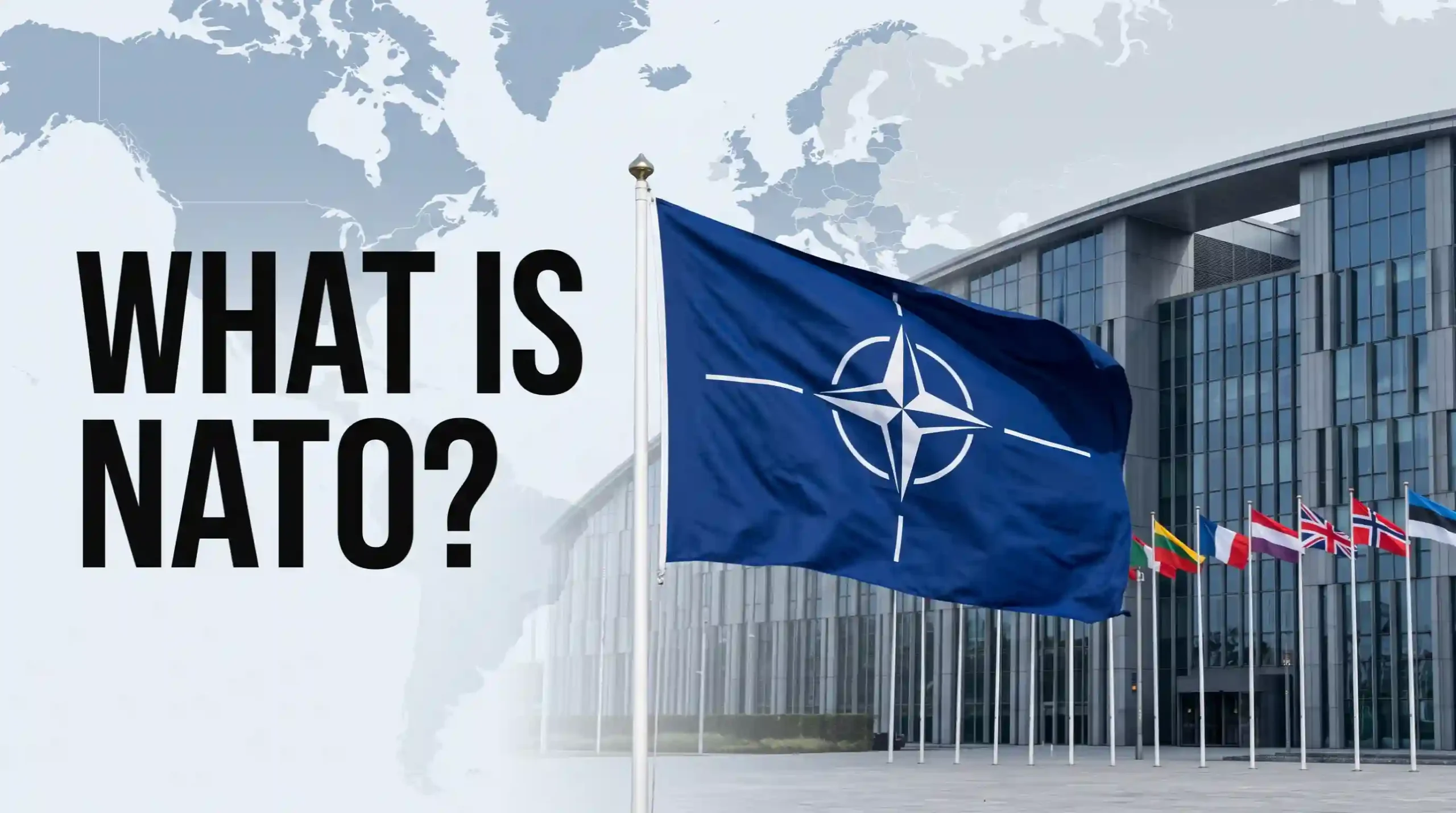
NATO, the North Atlantic Treaty Organization, is a political and military alliance founded in 1949 to safeguard the freedom and security of its members. It has 32 member countries across Europe and North America and operates through political and military cooperation based on the shared values of democracy, individual liberty and the rule of law.
Collective defence lies at the centre of the alliance. Under Article 5 of the North Atlantic Treaty, an armed attack against one member is considered an attack against all. The provision has been invoked only once, following the 11 September 2001 attacks on the United States, and remains central to NATO’s approach to the security threats facing its members.
Key facts about NATO:
- Founded: 4 April 1949 in Washington, D.C.
- Headquarters: Brussels, Belgium (since 16 October 1967)
- Current members: 32 countries
- Current Secretary General: Mark Rutte (took office in 2024)
- Official languages: English and French
- Core principle: Collective defence under Article 5
NATO’s work is organised around three core tasks: deterrence and defence, crisis prevention and management, and cooperative security. Its civilian structure oversees political consultation and decision-making, while its military command structure is responsible for military planning and operations. Both are examined in detail later in this article.
READ ALSO- Jordan Bardella Denies Mediapart Report on Antisemitic Comments
Why NATO Was Created
NATO emerged from the devastation of the Second World War and the growing Cold War tensions between the Western powers and the Soviet Union. Its creation, however, was driven by more than the threat of Soviet expansion. By 1945, roughly 36.5 million Europeans had died, including 19 million civilians. Refugee camps and rationing were part of daily life across the continent, infant mortality reached one in four in some areas, and in Hamburg alone half a million people were homeless. Learn more about why NATO was formed and the events that led to its creation in 1949.
In the years after the war, the Soviet Union installed communist governments across most of Eastern Europe, creating a buffer zone intended to protect the USSR from attack. In February 1948, the Communist Party of Czechoslovakia, backed covertly by Moscow, overthrew the country’s democratically elected government. The takeover increased Western concerns about the expansion of Soviet influence in Europe.
Events in Berlin soon deepened those concerns. As the Western powers moved towards the political and economic consolidation of West Germany, the Soviet Union blockaded the Western-controlled sectors of Berlin. From June 1948 to May 1949, the blockade cut off land access to the city, prompting the United States and its allies to organise a large-scale airlift. The crisis strengthened the case for closer military cooperation between North America and Western Europe.
NATO was created around three broader goals: deterring Soviet expansion, preventing the revival of nationalist militarism in Europe through a strong North American presence on the continent, and encouraging European political integration.
Western European countries had already begun pursuing closer military cooperation, including through the Western Union established in 1948. But European governments ultimately concluded that regional arrangements alone were not enough. A transatlantic security agreement was needed to deter Soviet aggression, limit the return of European militarism and provide a foundation for deeper political integration.
The North Atlantic Treaty and NATO’s Foundation
The North Atlantic Treaty, also known as the Washington Treaty, was signed on 4 April 1949 in Washington, D.C. Its 12 founding members were Belgium, Canada, Denmark, France, Iceland, Italy, Luxembourg, the Netherlands, Norway, Portugal, the United Kingdom and the United States.
The treaty’s preamble affirms the signatories’ commitment to peace, democratic government, individual freedom and the rule of law, and reaffirms their support for the United Nations Charter.
The treaty contains 14 articles. Article 1 commits members to settling disputes peacefully and avoiding the use of force inconsistent with UN principles. Article 2, sometimes called the “Canadian Article,” focuses on non-military cooperation, including strengthening free institutions and economic collaboration. Article 3 requires members to maintain their individual and collective capacity to resist armed attack through continuous self-help and mutual aid, and Article 4 provides for consultation whenever a member believes its territorial integrity, political independence or security is threatened.
Article 5 is the collective defence clause and the treaty’s central provision — its meaning and history are explained in the dedicated section below. Article 6 defines the geographic area that Article 5 covers, and Article 9 establishes the North Atlantic Council as NATO’s principal political decision-making body. Article 10 allows new members to join by unanimous agreement, a process explained further in the enlargement section that follows. Article 12 provides for a treaty review after ten years, and Article 13 allows a member to withdraw one year after giving notice, once the treaty has been in force for twenty years.
Notably, the treaty does not require members to respond to an attack with military force specifically; each member retains the freedom to choose how it responds, though military assistance is generally assumed. This is a looser obligation than Article IV of the Treaty of Brussels, which explicitly requires a military response.
NATO’s headquarters has moved several times. The alliance was first based at 13 Belgrave Square in London from 1949 to 1951, before relocating to Paris in April 1952 — first to the Palais de Chaillot, then to a purpose-built site at Porte Dauphine in 1960. France’s 1966 withdrawal from NATO’s integrated military command, discussed further in the challenges section below, forced another move, and NATO Headquarters was inaugurated in Brussels on 16 October 1967, built in just six months.
By 1999, NATO’s leaders recognised that the 1967 building no longer met the alliance’s needs, and construction of a new headquarters began in 2010 on a site across the road from the old one. The new building opened on 25 May 2017, with the move completed in 2018. It stands 32 metres high, covers more than 250,000 square metres across 49 hectares, and accommodates around 4,000 people.
How NATO Has Expanded Since 1949
NATO has grown from 12 founding members to 32 countries through ten rounds of enlargement, most recently with Sweden’s accession in 2024. Article 10 of the North Atlantic Treaty allows any European state that can further the treaty’s principles and contribute to North Atlantic security to be invited to join, provided all existing members agree by consensus through the North Atlantic Council.
Timeline of NATO enlargement
| Date | Enlargement |
|---|---|
| 4 April 1949 | The 12 founding members sign the North Atlantic Treaty in Washington, D.C. |
| 18 February 1952 | Greece and Türkiye join NATO |
| 6 May 1955 | West Germany joins NATO |
| 30 May 1982 | Spain joins NATO |
| 12 March 1999 | Czechia, Hungary and Poland join NATO |
| 29 March 2004 | Bulgaria, Estonia, Latvia, Lithuania, Romania, Slovakia and Slovenia join NATO |
| 1 April 2009 | Albania and Croatia join NATO |
| 5 June 2017 | Montenegro joins NATO |
| 27 March 2020 | North Macedonia joins NATO |
| 4 April 2023 | Finland joins NATO |
| 7 March 2024 | Sweden joins NATO |
Membership has never required identical participation from every country. Iceland joined as a founding member despite having no armed forces, and France remained a member even after withdrawing from the integrated military command in 1966, rejoining fully in 2009.
Greece and Türkiye: Both countries joined in 1952, strengthening NATO’s southern flank. Greece was recovering from civil war, while Türkiye faced Soviet pressure over strategically important maritime routes.
West Germany: West Germany became NATO’s 15th member in 1955, after years of debate over how to integrate the country into Western defence. An earlier French proposal for a European Defence Community collapsed in the French parliament, so West Germany instead joined the Western European Union, and its status as an occupied country ended under the Bonn-Paris conventions on 5 May 1955 — it joined NATO the following day. Moscow responded within days: the Soviet Union and seven Eastern European states signed the Warsaw Pact on 14 May 1955. When Germany reunified on 3 October 1990, the territory of the former East Germany became part of the Federal Republic and, with it, part of NATO.
Spain: Spain joined in 1982 during the political transition that followed Francisco Franco’s dictatorship. It initially stayed outside NATO’s integrated military structure, a position confirmed by a 1986 referendum, before its parliament approved full participation in 1996.
The first post-Cold War round (1999): The fall of the Berlin Wall and the collapse of the Warsaw Pact created the conditions for closer ties between NATO and the new democracies of Central and Eastern Europe. At the 1994 Brussels Summit, NATO launched the Partnership for Peace, a framework for practical cooperation with countries that were not members. The initiative later became an important part of NATO’s relationships with states seeking closer ties to the alliance. NATO’s 1995 Study on Enlargement concluded that admitting new members could support security across the Euro-Atlantic area, and at the 1997 Madrid Summit, Czechia, Hungary and Poland were invited to begin accession talks. They joined in March 1999, becoming the first former Warsaw Pact states in the alliance. NATO subsequently launched the Membership Action Plan at the 1999 Washington Summit to help prospective members prepare for accession, without guaranteeing eventual membership.
Seven countries join (2004): NATO’s largest single enlargement came in March 2004, when Bulgaria, Estonia, Latvia, Lithuania, Romania, Slovakia and Slovenia joined after participating in the Membership Action Plan following invitations at the 2002 Prague Summit. This round brought the three Baltic states into the alliance for the first time.
Albania and Croatia (2009): Both countries joined in April 2009 after years in the Membership Action Plan — Albania since 1999, Croatia since 2002 — and after signing Accession Protocols in July 2008.
Montenegro (2017): Montenegro became NATO’s 29th member in June 2017. After regaining independence in 2006, it joined the Partnership for Peace that year and entered the Membership Action Plan in 2009, cooperating with NATO on defence reforms and munitions destruction, and supporting the mission in Afghanistan, before signing its Accession Protocol in May 2016.
North Macedonia (2020): North Macedonia became the 30th member in March 2020, following a long process complicated by a dispute with Greece over its name. It had joined the Partnership for Peace in 1995 and the Membership Action Plan in 1999. The 2018 Prespa Agreement resolved the naming dispute, and the country was recognised as the Republic of North Macedonia in February 2019, clearing the way for accession the following year.
Finland and Sweden (2023-2024): Finland and Sweden both joined the Partnership for Peace in 1994 and built close ties with NATO over the following decades while maintaining policies of military non-alignment. Russia’s full-scale invasion of Ukraine in February 2022 led both governments to abandon that stance. They applied for membership on 18 May 2022, were invited to join at the Madrid Summit on 29 June, completed accession talks on 4 July, and signed Accession Protocols the next day. Finland deposited its Instrument of Accession on 4 April 2023, becoming NATO’s 31st member; Sweden followed on 7 March 2024 as the 32nd. The alliance remains open to further enlargement under Article 10, though any new invitation still requires the consensus of all existing members.
NATO’s 32 Member Countries
NATO has 32 member countries across Europe and North America, up from the 12 countries that founded the alliance in 1949.
How NATO Works
NATO operates through political consultation, collective decision-making and military cooperation. Its civilian structure handles political discussions and policy decisions, while its military structure is responsible for military planning and the execution of agreed measures and operations.
All NATO decisions are made by consensus. There is no formal voting system in which a majority can impose a decision on other members. Instead, Allies consult and discuss an issue until they reach an agreement that every member country can accept. This gives all 32 members a voice in the Alliance’s decisions, regardless of their size or military strength.
NATO Headquarters in Brussels is the main venue for these consultations. Representatives of member countries meet there to discuss political and military issues affecting their security and to coordinate the Alliance’s response.
The North Atlantic Treaty also provides a formal mechanism for security consultations. Under Article 4, any member can request consultations when it believes that its territorial integrity, political independence or security is threatened. Poland invoked Article 4 in 2014 following Russia’s annexation of Crimea. Eight members — Bulgaria, Czechia, Estonia, Latvia, Lithuania, Poland, Romania and Slovakia — requested consultations after Russia launched its full-scale invasion of Ukraine on 24 February 2022.
NATO’s work extends beyond the collective defence of its members. Crises and conflicts outside Allied territory can affect the security of member countries, so the Alliance also works to prevent and manage crises and cooperates with non-member countries and international organisations.
These relationships are developed through several partnership frameworks. The Partnership for Peace, launched in 1994, established practical cooperation between NATO and countries in Europe and the former Soviet area. Other initiatives have expanded political dialogue and security cooperation with countries in the Mediterranean, the Gulf region and beyond.
NATO also consults with partners on security issues that affect more than one region. At the 2024 Washington Summit, Allied leaders met with representatives from Australia, Japan, New Zealand, South Korea and the European Union to discuss shared security concerns.
The Alliance’s broader direction is set out in its Strategic Concept. This document defines NATO’s security priorities and provides political and military guidance on how the Alliance intends to pursue them. The 2022 Strategic Concept identifies three core tasks: deterrence and defence, crisis prevention and management, and cooperative security.
Once NATO members reach a decision, responsibility for carrying it out passes to the relevant part of the organisation. Political decisions may be taken forward through committees working under the North Atlantic Council, while military decisions and operations are implemented through NATO’s command structure.
NATO’s Leadership and Decision-Making System
The North Atlantic Council is NATO’s principal political decision-making body, made up of Permanent Representatives, or Ambassadors, from every member country. It meets at least weekly, and more often when needed, and also convenes at the level of Foreign and Defence Ministers and Heads of State and Government during summit meetings.
The Council is chaired by the Secretary General, NATO’s chief civilian official, who helps guide members toward consensus. The first Secretary General, Lord Ismay of the United Kingdom, was appointed in 1952 and famously summarised NATO’s early purpose as being “to keep the Russians out, the Americans in, and the Germans down.” Jens Stoltenberg of Norway served as Secretary General from 2014 to 2024, when Mark Rutte, the former Dutch prime minister, succeeded him.
NATO’s International Staff supports the Council and its subordinate committees, drawing on national delegations organised into divisions such as Political Affairs, Economics and Finance, Defence Policy and Planning, Defence Investment, and Public Diplomacy.
Summit meetings bring together Heads of State and Government at irregular intervals to introduce new policy, invite new members, launch major initiatives or reinforce partnerships. Between 1949 and the end of the Cold War, NATO held only ten summits over more than 40 years; the pace has picked up considerably since 1990. Summit decisions are typically published as declarations or communiqués that guide the alliance’s subsequent work — the Hague Summit in June 2025 was one example, producing several such documents alongside new commitments on defence investment, covered in the funding section below.
NATO Article 5 and Collective Defence
Article 5 sets out NATO’s collective defence commitment. It states that an armed attack against one or more members in Europe or North America is treated as an attack on all of them, and it commits every Ally, exercising the right of self-defence recognised under the UN Charter, to help the country under attack by whatever means it judges necessary — including armed force — to restore security in the North Atlantic area.
Article 6 defines the geographic reach of that commitment: it covers the territory of any member in Europe or North America, the former Algerian departments of France (no longer applicable since Algerian independence), the occupation forces of any member in Europe, and islands under any member’s jurisdiction in the North Atlantic area north of the Tropic of Cancer, along with vessels and aircraft operating in that area.
NATO has invoked Article 5 only once. Hours after the 11 September 2001 attacks on the United States, the North Atlantic Council agreed that if the attacks were found to have been directed from abroad, they would be treated as covered by Article 5. Once the United States had presented evidence tying the attacks to al-Qaida, the Council confirmed on 2 October 2001 that Article 5 applied — the only time the clause has been formally triggered in NATO’s history.
The attacks showed that a non-state group — al-Qaida, operating from Afghanistan — could use a country as a base to export instability well beyond its own borders. NATO responded with Operation Eagle Assist, which saw NATO AWACS aircraft patrol American skies from October 2001 to May 2002, and Operation Active Endeavour, a naval deployment to the Mediterranean to deter and detect terrorist activity that continued until 2016.
NATO has since extended the scope of collective defence to new domains. On 15 June 2016, it recognised cyberspace as an operational domain of warfare alongside land, sea and air, meaning a serious cyberattack on a member could in principle trigger Article 5. On 4 December 2019, it made the same recognition for space. More recently, elements of the NATO Response Force were activated in March 2022 following Russia’s invasion of Ukraine — the first such activation in NATO’s history — though Article 5 itself was not invoked.
NATO Military Structure
The NATO Command Structure is built around permanent multinational headquarters at the strategic, operational and component levels, distributed across member countries and funded collectively. It gives every Ally a role in the command and control of NATO’s operations, missions and activities across all military domains, and today maintains around 6,800 posts across seven commands. The structure operates under the authority of the Military Committee, NATO’s highest military body, composed of the Chiefs of Defence of all member countries, which advises the North Atlantic Council on military matters.
NATO has two strategic commands. Allied Command Operations (ACO) plans and executes NATO’s military operations as directed by the Council. It is led by the Supreme Allied Commander Europe (SACEUR) from Supreme Headquarters Allied Powers Europe (SHAPE) in Mons, Belgium, and includes two Joint Force Commands — in Brunssum, the Netherlands, and Naples, Italy — along with three tactical-level commands covering air, land and maritime forces.
Allied Command Transformation (ACT) leads the alliance’s military modernisation efforts. It is led by the Supreme Allied Commander Transformation (SACT) from headquarters in Norfolk, Virginia, and is responsible for education, training, exercises and interoperability across the alliance. ACT operates the Joint Analysis and Lessons Learnt Centre in Lisbon, Portugal, the Joint Force Training Centre in Bydgoszcz, Poland, and the Joint Warfare Centre in Stavanger, Norway.
The Command Structure dates to December 1950, when the North Atlantic Council appointed General Dwight Eisenhower as the first SACEUR. Eisenhower arrived in Paris in January 1951 and began work on SHAPE, then located at Rocquencourt west of the city; the Council formally approved the command structure’s foundational document on 18 December 1951, and Allied Command Atlantic and Allied Command Channel followed in early 1952. The structure was significantly downsized in 1997, cutting the number of headquarters from 65 to 20, and restructured again in 2003, when SACLANT’s headquarters was abolished, Allied Command Transformation was established in Norfolk, and SHAPE became the headquarters of Allied Command Operations.
NATO revisited the structure again in 2026. On 6 February, Allies agreed to hand two of the three Joint Force Commands to European officers: the United Kingdom took over Joint Force Command Norfolk and Italy took over Joint Force Command Naples, both previously led by American admirals, while Germany and Poland share rotating command of Joint Force Command Brunssum. The United States retained the Supreme Allied Commander Europe post, which has always gone to an American officer, along with all three of NATO’s theatre component commands, covering land, air and maritime forces.
Major NATO Operations and Missions
NATO’s current operations range from long-standing peacekeeping deployments to newer missions launched after Russia’s invasion of Ukraine.
Current operations
| Operation/mission | Location | Started | Purpose |
|---|---|---|---|
| Kosovo Force (KFOR) | Kosovo | 1999 | Maintains a safe environment for all communities in Kosovo; one of NATO’s longest-running missions, with around 4,500 Allied and partner troops |
| NATO Mission Iraq | Iraq | 2018 | Trains and advises Iraqi security forces |
| Sea Guardian | Mediterranean Sea | 2016 | Maritime security operation, evolved from Operation Active Endeavour |
| Baltic Air Policing | Estonia, Latvia, Lithuania | 2004 | Fighter jets respond to unwanted aerial intrusions over Baltic airspace |
| Forward Land Forces (formerly Enhanced Forward Presence) | Baltic states, Poland, Bulgaria, Hungary, Romania, Slovakia, Finland | 2017 | Multinational battlegroups deployed as a deterrent; expanded repeatedly since Russia’s 2022 invasion of Ukraine |
| Airborne Early Warning and Control | NATO airspace | Ongoing | AWACS aircraft provide airborne surveillance and command and control; contracted to operate until 2035 |
| Arctic Sentry | Arctic and High North | February 2026 | An enhanced vigilance activity, not a formal operation, that brings Allied Arctic exercises and deployments under one coordinated framework |
Since Russia’s full-scale invasion of Ukraine in February 2022, NATO has added battlegroups in Bulgaria, Hungary, Romania and Slovakia, activated elements of the NATO Response Force for the first time in its history, and placed the aircraft carrier USS Harry S. Truman and its strike group under NATO command — the first time a full U.S. carrier group has served under NATO command since the Cold War.
Historical operations
| Operation/mission | Location | Duration | Purpose |
|---|---|---|---|
| International Security Assistance Force (ISAF) | Afghanistan | 2003-2014 | NATO’s first operation outside the Euro-Atlantic area; helped stabilise the country |
| Resolute Support Mission | Afghanistan | 2015-2021 | Trained and advised Afghan security forces after ISAF ended |
| Operation Allied Force | Kosovo and Serbia | 24 March-10 June 1999 | Air campaign to halt ethnic cleansing in Kosovo; flew 38,000 sorties over 78 days |
| Implementation Force (IFOR) | Bosnia and Herzegovina | 1995-1996 | UN-mandated force of 60,000 troops that enforced the Dayton Peace Agreement |
| Stabilisation Force (SFOR) | Bosnia and Herzegovina | 1996-2004 | Continued IFOR’s mission before handover to the European Union |
| Operation Unified Protector | Libya | 2011 | UN-mandated mission to protect civilians under attack from their own government |
NATO’s Relationship with Russia and Ukraine
NATO and Russia
NATO’s ties with Moscow have shifted repeatedly since the Cold War. In 1954, the Soviet Union proposed joining NATO to help preserve peace in Europe; NATO members rejected the idea, suspecting it was designed to weaken the alliance from within.
Relations later warmed. At the 1997 Paris Summit, NATO and Russia signed the Founding Act on Mutual Relations, Cooperation and Security, declaring that the two were no longer adversaries and establishing the NATO-Russia Permanent Joint Council. In 2002, at the Rome Summit, they created the NATO-Russia Council, intended to let the two sides meet as equal partners.
That cooperation broke down after Russia’s annexation of Crimea in 2014, which NATO condemned and which prompted Poland to invoke Article 4. Practical NATO-Russia cooperation was suspended and has not resumed.
Russia’s full-scale invasion of Ukraine on 24 February 2022 marked a further deterioration. NATO leaders held an emergency virtual summit the following day to condemn the invasion and reaffirm support for Ukraine, then met in person in Brussels on 24 March 2022 to reset the alliance’s defence and deterrence posture across land, sea, air, cyber and space. At the Madrid Summit in June 2022, NATO adopted a new Strategic Concept that names Russia the “most significant and direct threat” to Allied security and to peace and stability across the Euro-Atlantic area, and agreed a more proactive defence posture. In response, NATO has carried out its largest reinforcement of collective defence since the Cold War.
NATO and Ukraine
NATO’s relationship with Ukraine dates to the 1997 Madrid and Paris Summits, which established the Charter on a Distinctive Partnership between the two. At the 2008 Bucharest Summit, NATO told Ukraine and Georgia they could eventually become members — a statement that drew sharp criticism from Russia. Support increased after the 2014 annexation of Crimea, and the 2021 Brussels Summit reaffirmed Ukraine’s right to choose its own foreign policy course.
Since the 2022 invasion, that support has deepened further. At the Vilnius Summit in July 2023, NATO agreed a multi-year assistance programme for Ukraine and held the first meeting of the new NATO-Ukraine Council, reaffirming that Ukraine will join the alliance once members agree and conditions are met. At the Washington Summit in July 2024, Allies reaffirmed Ukraine’s “irreversible path” to NATO membership, established NATO Security Assistance and Training for Ukraine (NSATU) to coordinate equipment and training, and confirmed the creation of the NATO-Ukraine Joint Analysis, Training and Education Centre (JATEC) to apply lessons learned from the war — alongside a substantial funding commitment detailed in the section below. Ukrainian President Volodymyr Zelenskyy joined NATO-Ukraine Council sessions at both the Vilnius and Washington summits, and continued support for Ukraine remained one of three key priorities at the Hague Summit in June 2025.
How NATO Is Funded
NATO’s finances combine national defence spending by individual members with common funding for shared infrastructure and the Command Structure described earlier.
At the 2014 Wales Summit, member states formally committed for the first time to spend a minimum of 2% of GDP on defence by 2024 — previously only an informal guideline. That pledge was renewed at the 2023 Vilnius Summit and reaffirmed at the 2024 Washington Summit, where Allies noted that two-thirds of members had already reached the 2% threshold.
At the Hague Summit in June 2025, Allies committed to a new target of 5% of GDP annually on defence and security by 2035, split between 3.5% for core defence requirements and 1.5% for related areas such as critical infrastructure protection — more than double the 2% goal set in 2014.
Alongside spending commitments, NATO endorsed a Defence Production Action Plan at the 2023 Vilnius Summit to speed up joint procurement, improve interoperability and expand production capacity; an updated version of the plan was released at the 2025 Hague Summit. The share of the total burden carried by European members has changed considerably over the decades: they accounted for 34% of NATO’s total military spending in 1991, a figure that had fallen to 21% by 2012.
Ukraine has also become a significant funding priority. At the 2024 Washington Summit, Allies announced a minimum baseline of EUR 40 billion in funding for Ukraine over the following year, alongside a commitment to sustainable levels of security assistance going forward.
Challenges Facing NATO Today
NATO’s challenges today span external threats, internal disagreements among members, and questions about the balance of responsibility between North America and Europe.
On the external side, cyberattacks against members have become more frequent and more damaging, and the rise of ISIL extended the reach of terrorism across multiple continents. Disinformation and propaganda spread through social media have also become a persistent concern, aimed at undermining the democratic values NATO was built to protect.
The alliance has faced internal strains as well. In 1966, France withdrew all of its forces from NATO’s integrated military command and asked non-French NATO troops to leave French territory. President Charles de Gaulle objected to the dominant U.S. role within NATO and what he saw as a special relationship between Washington and London, and the dispute forced SHAPE to relocate from Rocquencourt, near Paris, to Casteau, Belgium, by October 1967. France did not return to full participation until the 2009 Strasbourg-Kehl summit.
Greece and Türkiye have had their own disputes. Following Türkiye’s invasion of Cyprus in 1974, Greece withdrew from NATO’s military command structure, returning in 1980 with Turkish cooperation. Tensions between the two countries have continued over issues including Türkiye’s interventions in Syria and Libya and disputes over Cyprus’s maritime zones. Relations between the U.S. and Türkiye have also been strained: in August 2018, the U.S. Treasury sanctioned two senior Turkish ministers over the detention of American pastor Andrew Brunson, and President Recep Tayyip Erdoğan said the move would push Türkiye to seek new allies — one of the more serious diplomatic disputes between NATO members in recent years.
Questions about burden-sharing between the United States and Europe resurfaced in December 2024, when then President-elect Donald Trump suggested he might support U.S. withdrawal from NATO over low European defence spending and said he would not defend Allies that fell short of the 2% GDP target.
Tensions escalated further in January 2026, when Trump renewed his long-standing interest in acquiring Greenland, an autonomous Danish territory, and did not rule out using force to do so; Denmark’s prime minister warned that any such move would effectively end NATO. Denmark and several European Allies — including France, Germany, Norway, Sweden, Finland, the Netherlands and the United Kingdom — responded by deploying troops to Greenland under the Danish-led Operation Arctic Endurance. Trump stepped back from his threats of force and tariffs at the World Economic Forum in Davos on 21 January 2026, after which he and NATO’s Secretary General agreed the alliance should take on a larger collective role in Arctic security. That agreement led to Arctic Sentry, launched on 11 February 2026 to coordinate Allied military activity across the High North — the same month NATO gave European officers a larger share of its senior command posts, as described earlier.
Trump also floated the idea of Canada becoming the 51st U.S. state at various points between late 2024 and 2025. Canadian leaders — first Justin Trudeau and then his successor as prime minister, Mark Carney, who took office in 2025 — firmly rejected the idea, and Carney said by mid-2025 that Trump no longer appeared to be pursuing it. The episode nonetheless contributed to a rise in Canadian nationalism and boycotts of American-made goods.
NATO has also broadened its agenda to include emerging, non-traditional security issues. At the 2022 Madrid Summit, Allies agreed to integrate climate change considerations across the alliance’s core tasks, and NATO continues to work with other international and non-governmental organisations on institution-building, governance, development and judicial reform.