


The phone lights up before the alarm even sounds, and by the time it’s in your hand, a small chain of software decisions has already run its course. A face has been scanned and matched against a stored pattern. A night’s worth of email has been sorted, and most of the junk never reached the inbox. None of it needed a chatbot, a prompt, or even a conscious request. It happened because AI is changing your daily life in ways so routine that most people simply stopped noticing.
By the time coffee is made, more of it will have run. A search for a nearby pharmacy returns a synthesized answer instead of ten blue links. A map reroutes around traffic that hasn’t happened yet. A video app decides, before any thought goes into it, what plays next. Somewhere in the background, a bank’s fraud system is watching a stream of transactions for anything that looks wrong. For a lot of people, the word “AI” still calls to mind a chatbot window or an image generator. The more accurate picture is closer to plumbing — it has been running underneath ordinary digital life for years, quietly enough that its presence rarely gets a second thought.
A Day That Runs on AI Before You’ve Noticed
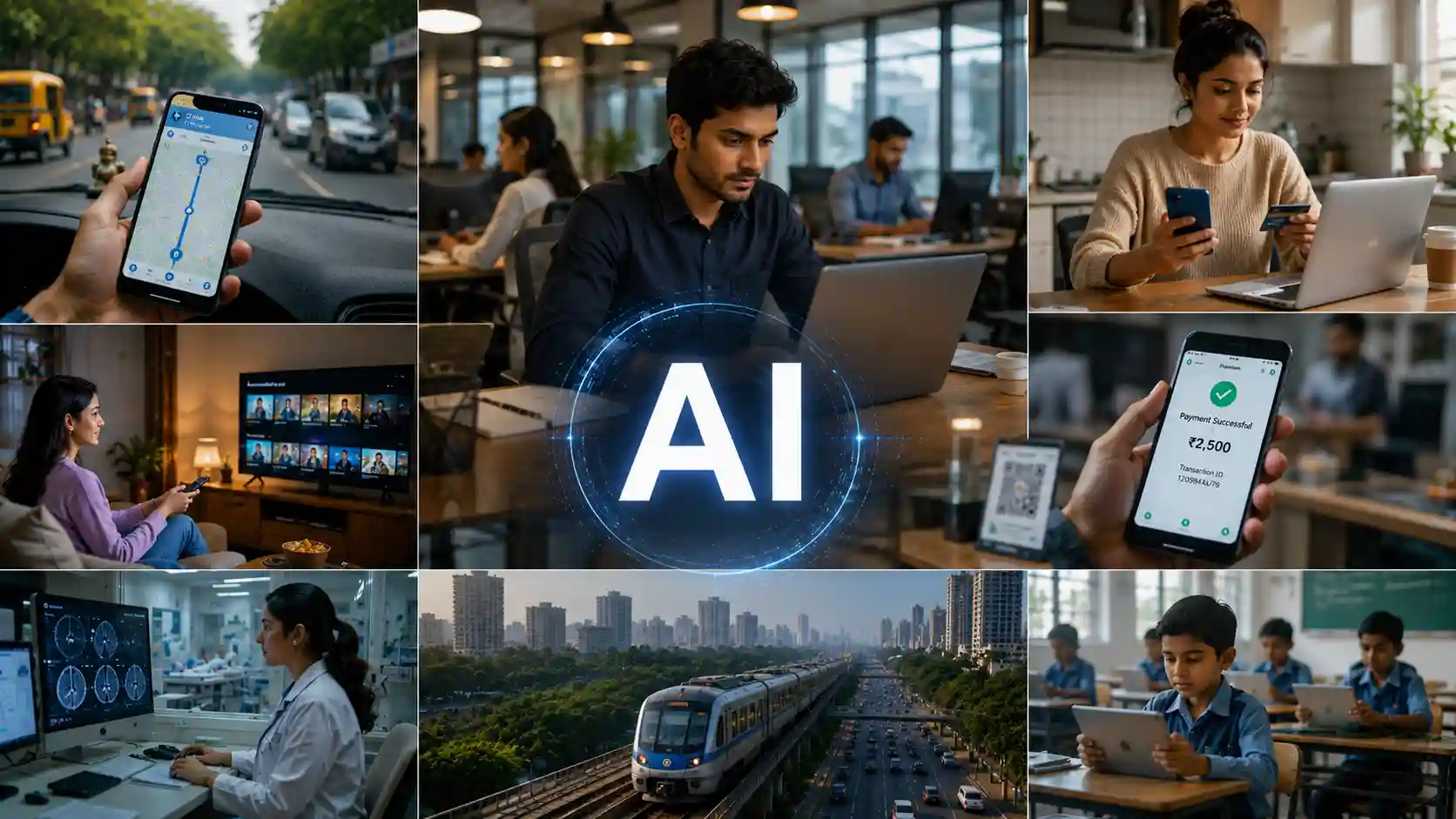
Picture an ordinary weekday for someone in Mumbai. They wake up, unlock the phone with their face, and scroll past emails a spam filter has already triaged. A search for “best monsoon shoes” returns AI-organized results rather than a plain list of pages. The commute to work is shaped by a navigation app quietly recalculating the fastest route as traffic shifts in real time. Lunch break means fifteen minutes of YouTube, and the app has already decided, based on past viewing, what shows up next. An online purchase that evening comes with product suggestions built from browsing history, and the UPI payment that follows gets screened in the background by fraud-detection software before it clears.⇲
None of these moments announce themselves, and part of the reason is where the computing actually happens. Some of it runs directly on the device: face unlock and camera processing are usually handled locally, which keeps them fast and keeps sensitive biometric data off a remote server. Other tasks, like generating a search summary or running a streaming recommendation engine, need the scale of a data center and only work with a live connection. A middle category — voice assistants and some smart-home systems — splits the difference, doing basic recognition on the device and sending anything complex to the cloud.
The appeal is straightforward: less time spent on small decisions, fewer typos, faster answers, a payment system that flags fraud before money disappears. The trade-offs are less visible but just as real. Every one of these conveniences runs on data collected about the person using it, and the systems making these micro-decisions are not immune to error or bias. Both things are true at once, which is a more useful way to think about AI day to day than treating it as either a harmless convenience or a hidden threat.⇲
The Phone Doing More Than You Asked It To
Nowhere is this more concentrated than in the smartphone. A modern phone camera isn’t simply capturing light through a lens; it’s running a small production pipeline. Take a photo in a dim restaurant, and the camera often captures several frames in rapid succession, merges them, brightens shadows, and sharpens edges — sometimes even removing a stranger who wandered into the background — before the shutter sound finishes playing. The resulting photo then gets sorted automatically into an album under a label like “dinner” or “friends,” without anyone tagging a single image.
The same logic runs through the phone’s security and communication layers. Facial recognition and fingerprint scanning rely on pattern-matching systems trained to tell a live face from a photo held up to the camera — a defense against the simplest kind of spoofing attempt. Typing a message pulls in predictive text and autocorrect; dictating one triggers transcription and a set of suggested replies, drafted by the same underlying language technology that powers voice assistants like Google Assistant and Siri. In the background, the operating system is constantly adjusting battery usage and app performance, deciding which processes get power and which can idle.
More recently, this has expanded into features people are more likely to notice on purpose: AI-generated photo edits, real-time translation of a foreign menu through the camera, one-tap summaries of long articles or documents. Some of this runs entirely on the phone, which tends to be faster and keeps personal data local. Other features, like a detailed generative edit or live translation, lean on cloud servers with far more computing power, at the cost of needing an active connection.⇲
The upside is a phone that takes less conscious effort to use well: better photos without editing skill, faster typing, longer battery life between charges. The downside sits in the same place it does everywhere else AI touches personal devices — voice recognition still misfires sometimes, generative features can be used to alter images in misleading ways, and every convenience depends on data being collected somewhere to make the prediction work.⇲
What Changes Once AI Reaches the Office
Move from the pocket to the desk, and the pattern repeats at a larger scale. Tools like Google Gemini and Microsoft Copilot now sit inside the same word processors and email clients office workers have used for decades, drafting replies, summarizing long documents, and suggesting edits to a paragraph in progress. Video calls increasingly come with automatic transcription attached, producing a summary and a list of action items the moment the meeting ends, so nobody has to rely on memory or hurried notes.
Software development has absorbed AI just as deeply. Coding assistants like GitHub Copilot and Cursor suggest completed lines or entire functions as a developer types, and can flag likely bugs before code ships. Security teams lean on similar pattern-recognition systems to catch phishing attempts and unusual network activity in real time, often faster than a human analyst working through logs by hand. Across most of these tools, the actual time saved tends to come less from replacing whole tasks and more from compressing the slow, unglamorous parts of a job — first drafts, transcription, routine debugging — into minutes instead of hours.
The scale of adoption bears this out. Globally, 58% of employees say they use AI regularly at work, and in India, China, and Nigeria that figure climbs past 80%.⇲ An employee in Bangalore might use AI to draft a client email before lunch, summarize a fifty-page vendor report by mid-afternoon, and walk out of a client call with a meeting summary already sitting in their inbox — often without opening a dedicated AI product at all, since these tools are increasingly built directly into the software people already use.
None of this is friction-free. The same automation that saves an employee an hour of transcription also raises real questions about which tasks, and eventually which jobs, still need a person attached to them — a question that comes back with sharper edges later, at the level of the wider economy rather than a single afternoon.
How AI Is Changing Your Daily Life Every Time You Open an App
Step outside the office and onto any of the apps people open dozens of times a day, and the personalization becomes even more direct: decisions about what shows up on a screen get made before anyone consciously asks for anything at all. A search on Google no longer just returns links — AI Overviews synthesize an answer by pulling from multiple sources at once, and a newer AI Mode lets people ask follow-up questions the way they would in a conversation.
Social platforms — Instagram, TikTok, YouTube — run on a similar principle in a different form: a feed built moment to moment from engagement and watch-time signals rather than a fixed chronological order. Streaming services do the same with entertainment, blending collaborative filtering (what people with similar taste watched next) with content-based filtering (what’s similar to what’s already been watched) to decide what shows up on a Netflix or Spotify homepage.
The clearest illustration of how personal this has become is a simple thought experiment: two people search “best smartphone under ₹20,000” at the same moment. One, based on past browsing and location, sees a page dominated by budget Android options. The other sees mid-range phones from an entirely different set of brands. Neither search was wrong. Both were shaped by a profile of past behavior that neither person consciously built.
E-commerce platforms extend the same logic to shopping: product recommendations, and even the specific ads a person sees, are drawn from browsing and purchase history rather than shown identically to everyone.⇲ Early data from Reuters suggests that shoppers who arrive at a retail site through an AI-generated referral, such as a chatbot recommendation, tend to browse longer and spend more per visit than those arriving through a traditional search link — though this measures behavior after arrival, not proof that the AI referral caused the extra spending.⇲
The convenience of a feed, a search result, or a homepage built specifically for one person is real. So is the fact that no two people are seeing quite the same internet.
The Systems Behind Hospitals, Banks and Government Apps
Some of the most consequential uses of AI happen furthest from view, inside institutions people trust with their health, money, and legal standing. In healthcare, AI now assists with diagnosis, helps read medical scans alongside radiologists, and supports clinical documentation. One industry tracker puts the number of FDA-cleared AI-based medical tools at more than 1,400 as of 2026, and estimates that roughly three-quarters of hospitals now use AI in some clinical or administrative capacity.⇲ A patient in Delhi getting an X-ray reviewed with AI assistance and a farmer in Maharashtra receiving crop advice through a government app are drawing on the same underlying category of pattern-recognition technology, aimed at very different problems.⇲
Banking runs a parallel system almost entirely out of sight. Mastercard reports that AI-based fraud detection has meaningfully cut losses and false declines for banks by analyzing transaction patterns in real time and flagging anything that deviates from a customer’s normal behavior before a fraudulent charge clears. A widely repeated figure holds that around 90% of banks now use some form of AI-driven fraud detection, with false-positive fraud alerts cut by roughly 80% — though the original study behind that specific number is difficult to trace, and it’s included here as a commonly cited industry estimate rather than a confirmed statistic.
Education has absorbed a comparable wave of investment. Spending on AI-native education technology — platforms built around adaptive, personalized learning rather than AI added on top of older software — has crossed $180 billion since 2022, according to OECD-linked analysis. A student in Pune working with an AI tutor is part of the same trend as a school district piloting adaptive learning software anywhere else in the world.⇲ Transportation systems and public services draw on the same toolkit for quieter purposes: predicting traffic flow, scheduling vehicle maintenance before a breakdown happens, and running the chatbots that increasingly handle basic government service requests and tax queries.
One Person’s Habits, Multiplied Into a Trillion-Dollar Shift
Multiply any of this by a few billion daily interactions, and the individual picture turns into a global one. Worldwide spending on AI is projected to reach $2.52 trillion in 2026, and AI-focused companies attracted 61% of global venture capital funding in 2025, more than every other technology category combined.⇲ Healthcare alone shows the scale in miniature: the market for AI tools built specifically for clinical use, rather than AI added as a feature to existing hospital software, has already passed $37 billion.⇲
The employment picture is more contested, partly because different organizations measure “exposure to AI” differently. LinkedIn data cited by the World Economic Forum suggests AI has already added 1.3 million jobs globally, mostly in roles built around developing, deploying, and managing AI systems.⇲ A separate WEF analysis estimates that 40% of global employment is exposed to some degree of AI-driven change — a broad category running from full automation down to tasks simply getting faster.⇲ The International Labour Organization, using a narrower definition focused specifically on generative AI, puts the figure at 25% of global jobs sitting in occupations with meaningful generative AI exposure. The two numbers aren’t contradicting each other so much as measuring different things.⇲
A software engineer in Hyderabad coding faster with an AI assistant, a doctor in Mumbai using AI-assisted diagnosis, and a student in a rural Indian classroom accessing AI-powered instruction through a government platform are all, in their own way, contributing data points to these larger figures.⇲ The gains are not landing evenly, though. Adoption remains heavily concentrated in high-income countries with strong digital infrastructure, and the ILO has flagged a real risk that lower-income countries, with less capital to invest and less existing infrastructure to build on, could fall further behind rather than catch up.
The Part of the Story That Doesn’t Fit on a Feature List
None of this convenience is free of cost, and public opinion reflects that tension more than it reflects outright rejection. Globally, 59% of people say they see more benefits than drawbacks from AI, yet 52% also describe themselves as nervous about AI products specifically. Those aren’t contradictory positions so much as two sides of the same cautious attitude.⇲
Privacy sits near the top of that unease. In the United States, 71% of adults say they believe AI has made their personal data less secure — a concern grounded in how much of the personalization described earlier, from search results to product recommendations to camera enhancements, depends on continuous data collection to function.⇲ Bias raises a related but distinct problem. Systems trained on historical data can absorb and repeat the patterns in that data, including discriminatory ones, which becomes serious when the same kind of system is used to screen job applicants, evaluate loan applications, or support policing decisions. A qualified candidate rejected by an automated hiring filter trained on skewed historical data may never learn that a flawed pattern, rather than their actual qualifications, cost them the interview — the decision arrives without an obvious way to challenge the reasoning behind it.⇲
Generative AI has layered a newer problem on top of the older ones: content convincing enough to be mistaken for reality. A deepfake video of a public figure saying something they never said can spread faster than any correction, and the same generative tools used to enhance a phone photo can, in different hands, be used to fabricate one.
The employment question raised earlier in the office returns here with sharper edges. The ILO’s estimate that a quarter of global jobs carry meaningful generative AI exposure is concentrated most heavily in clerical and other highly digitized roles — the kind of routine, screen-based work that current AI systems find easiest to partially automate. And running underneath every one of these systems is a physical cost rarely visible from a phone screen: the data centers that train and run AI models consume large and growing amounts of electricity and water, a footprint that is becoming a serious point of debate as AI use keeps scaling rather than leveling off.
The Next Version Won’t Wait to Be Asked
What comes next looks less like new features bolted onto old products and more like a shift in how much a person has to ask for at all. Google and other major technology companies are already rolling out AI agents built to complete multi-step tasks with minimal supervision — booking a reservation, comparing prices across sites, managing parts of a calendar — rather than simply answering one question and stopping. One illustrative version of where this is headed: a user asks an assistant to plan a weekend trip to Goa, and the system books hotels, suggests activities, and adjusts the itinerary around the weather forecast, all from a single instruction rather than a dozen separate ones — a workflow that today is closer to a demonstration than something most people are actually doing.
Two other shifts are running alongside the rise of agents. On-device AI keeps getting more capable, letting phones and laptops handle tasks locally that used to require a round trip to a data center, which tends to improve both speed and privacy at once. And AI systems are becoming more multimodal, meaning a single model can work with text, images, audio, and video together instead of needing a separate tool for each — part of why search itself is drifting from a list of links toward something closer to a generated answer.
Some of the boldest numbers attached to this shift are genuine projections rather than settled facts, and deserve to be read that way. One frequently cited estimate suggests roughly 10% of U.S. adults could be using some form of daily AI companion by 2027, rising to as much as 30% by 2040 — a forecast, not a measurement of anything that has already happened, and one that depends heavily on assumptions about how both the technology and public attitudes toward it evolve over the next decade.
The Same Ordinary Moment, Seen Differently
Go back to that phone lighting up on the nightstand. Nothing about that moment has changed by the end of this article — the face unlock, the sorted inbox, the rerouted commute are all exactly as automatic as they were at the start. What’s changed is how that moment reads. A face scan is no longer just a lock screen opening; it’s a small, local AI model doing the same basic kind of pattern-matching that, at a larger scale, powers a hospital’s diagnostic tool or a bank’s fraud alert. A sorted inbox is the same technology, doing a smaller job.
That’s the more useful way to think about where this technology actually sits in an ordinary life: not as one dramatic arrival, but as thousands of small, mostly invisible decisions running constantly in the background of things people are already doing. AI is changing your daily life less through any single visible leap and more through the steady accumulation of these small decisions — which is exactly why they’re worth noticing now and then, rather than left to run entirely unexamined.