


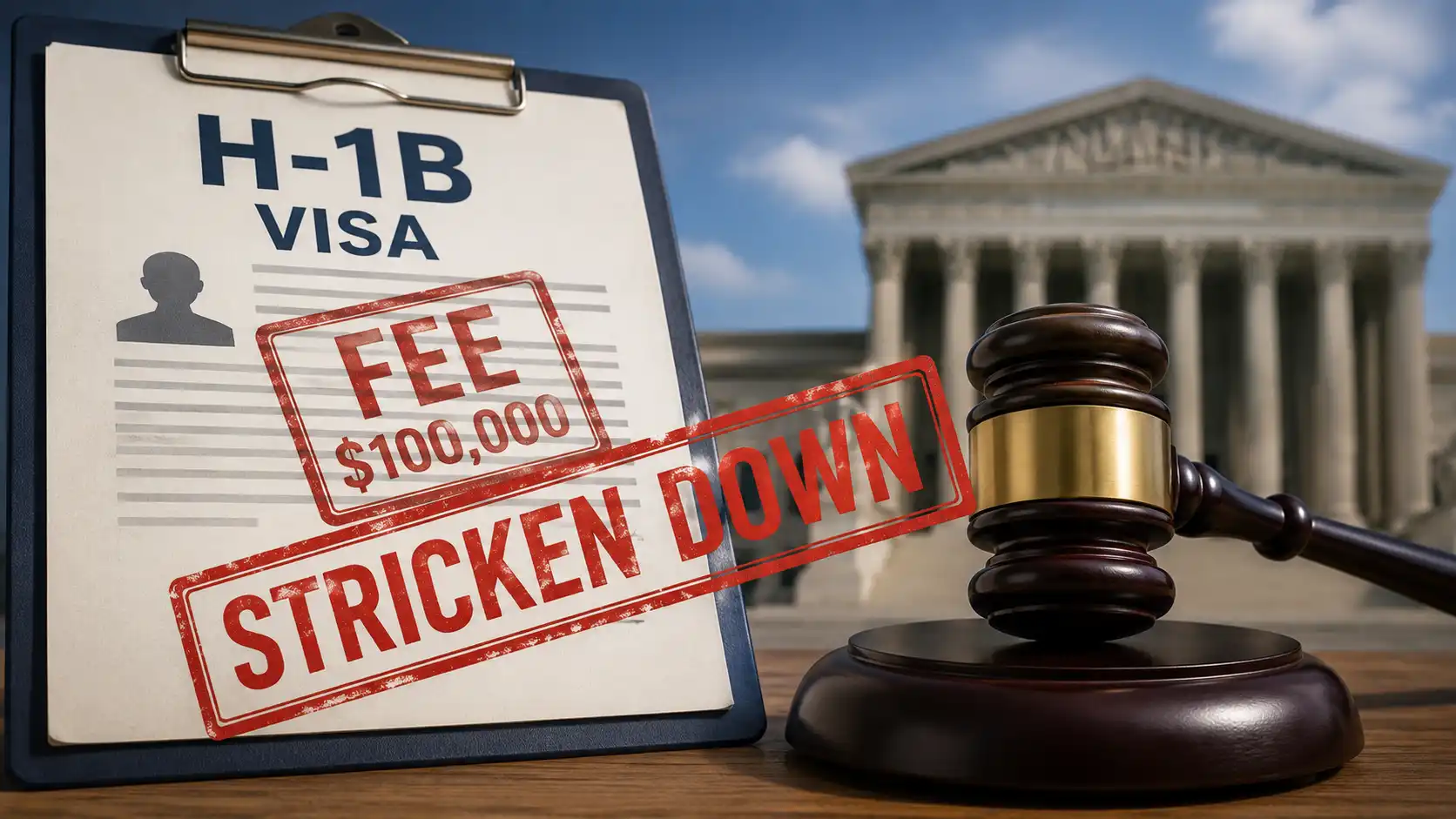
A Massachusetts federal court delivered a significant ruling on June 8, 2026, striking down the $100,000 fee that US President Donald Trump had imposed on new H-1B visa applications. The judge declared the fee unlawful, stating that it was introduced without the approval of the US Congress — a fundamental requirement under American law for any such financial imposition tied to federal immigration processes.
The ruling brought immediate relief to Indian diaspora communities, immigration advocates, and employers across the United States who had been watching the case closely since the fee was first announced.
Why the Court Declared the Fee Unlawful
President Trump had signed an executive proclamation in September 2025 adding the $100,000 charge to new H-1B visa applications. The administration positioned it as a measure to prioritize American workers. However, the court found a clear legal problem: the executive branch does not have the authority to unilaterally create major new financial requirements under immigration law without Congress passing legislation to back it.
The court held that the fee lacked the congressional approval required to support such a major immigration-related charge. With that legal foundation missing, the fee could not stand.
FIIDS Calls It a Restoration of Fairness
Indian diaspora advocacy organizations were quick to welcome the court’s decision. The Foundation for India and Indian Diaspora Studies (FIIDS) called it a move that restores predictability and fairness to the employment-based immigration system.
Khanderao Kand, Chief of Policy and Strategy at FIIDS, said access to highly skilled global talent remains essential for the continued growth of America’s technology, healthcare, and advanced manufacturing sectors. He also said the ruling helps preserve America’s competitive advantage in innovation, research, and entrepreneurship. He added that the ruling reinforces the principle that policy changes of this scale must be grounded in both statutory authority and economic realities.
Kand said FIIDS believes a merit-based, balanced immigration framework ultimately strengthens both US businesses and the broader economy — and that this ruling is a step in that direction.
Indiaspora Welcomes Decision, But Urges Caution
While the reaction was largely positive, not everyone was ready to celebrate without reservation. Sanjeev Joshipura, Executive Director of Indiaspora, acknowledged that all stakeholders connected with the H-1B Visa program would feel a sense of relief after the court order — but he was careful to add a note of caution.
Joshipura pointed out that the administration still has room to create procedural obstacles for H-1B visa holders through means that do not technically conflict with US law. He noted that if the executive branch wishes to pursue its stated policy preferences of limiting H-1B approvals, it can potentially do so through administrative and procedural mechanisms that are harder to challenge in court.
He also referenced the ongoing tension between the current administration and the judiciary as a reason to remain watchful about what comes next.
Why the H-1B Program Matters to the US Economy
Supporters of the H-1B program argue that access to highly skilled global talent remains important for sectors such as technology, healthcare, and advanced manufacturing. FIIDS echoed this view while welcoming the court’s decision and said the ruling helps preserve America’s competitive advantage in innovation, research, and entrepreneurship.
What the Ruling Means for Indian Professionals
For now, the ruling serves as a reminder that major immigration policy changes must rest on proper legal authority. How the H-1B Visa fee debate evolves from here remains to be seen.
For many Indian professionals and their families, this ruling carries particular significance. The proposed fee had raised concerns among stakeholders connected with the H-1B system.
The court’s decision has been welcomed by those affected by the program. However, as Joshipura cautioned, the administration may still create procedural obstacles that do not conflict with US law.